
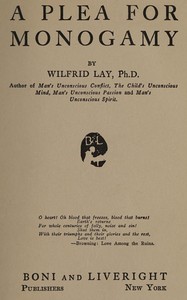
A Plea for Monogamy by Wilfrid Lay
Published in 1922, Wilfrid Lay's A Plea for Monogamy is a book born from crisis. The world had just been shattered by a global war, and traditional social structures were wobbling. In this atmosphere, Lay—a practicing psychologist—took up his pen to defend the institution of lifelong marriage against what he saw as a rising tide of destructive ideas.
The Story
There isn't a traditional plot with characters. Instead, Lay builds his case like a lawyer before a jury. He argues that humans are fundamentally wired for deep, exclusive attachment. The book walks through what he considers the psychological dangers of promiscuity, easy divorce, and the then-trendy concept of 'trial marriages.' He pulls examples from his clinical work, presenting stories of individuals he believes were harmed by abandoning monogamous commitment. For Lay, monogamy isn't just a social rule; it's the essential framework for achieving true intimacy, raising well-adjusted children, and creating a stable society. The central conflict is between this view and the emerging modern ideals of personal sexual freedom.
Why You Should Read It
Reading this today is a trip. It's easy to dismiss Lay as a conservative scold, but that misses the point. His passion is palpable, and his fear—that we're trading lasting happiness for fleeting pleasure—is an anxiety that still echoes in our endless podcasts and articles about dating and relationships. The book is a stark reminder that our current debates aren't new. Seeing these arguments made with the tools of early 20th-century psychology, rather than just religion, is fascinating. It forces you to question which of your own beliefs are timeless and which are just products of your era. You might finish it furious or thoughtful, but you won't be bored.
Final Verdict
This is a must-read for history lovers, sociology nerds, and anyone who enjoys a good, heated argument with a book. If you're interested in the history of marriage, psychology, or how past generations grappled with changing sexual morals, you'll find it gripping. It's also great for book clubs—guaranteed to spark a fierce discussion. Just be ready: Lay doesn't pull his punches, and his views will challenge modern readers. Approach it not as a guide, but as a compelling artifact from the front lines of a culture war that's still going on.
You are viewing a work that belongs to the global public domain. It serves as a testament to our shared literary heritage.
Paul Martin
3 months agoFrom a researcher's perspective, the step-by-step breakdown of the methodology is extremely helpful for students. It’s hard to find this much value in a single source these days.






John Rodriguez
2 months agoImpressive quality for a digital edition.