
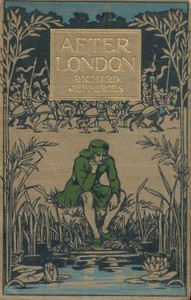
After London; Or, Wild England by Richard Jefferies
Imagine waking up centuries from now. The cities you know are gone, not as piles of concrete, but as myths. The very landscape has changed. This is the England Richard Jefferies imagines.
The Story
The book is split into two parts. The first, 'The Relapse into Barbarism,' is almost a documentary. It describes how, after an unspecified disaster, humanity dwindles and nature surges back. Forests swallow roads, new lakes form, and London becomes a toxic fog-bound swamp everyone avoids. It's a stunning, eerie setup.
The second part, 'Wild England,' follows Felix Aquila. He's a thoughtful, somewhat out-of-place son of a minor lord in a society that has reverted to a crude feudalism. Feeling stifled and inspired by old tales of the sea, he builds a canoe and sets out to explore the great inland lake that now covers central England. His journey is one of discovery and survival, encountering isolated communities, dangerous wildlife, and the constant struggle for power in a world with forgotten rules.
Why You Should Read It
What grabbed me wasn't a fast plot, but the profound sense of place. Jefferies, a nature writer at heart, makes the re-wilded England the true main character. You can feel the damp of the forests and the mystery of the silent waters. Felix's quest isn't to save the world; it's to find his place in a new one. The book asks quiet questions about civilization, progress, and what remains of 'us' when all our infrastructure crumbles. It's melancholic but also filled with a weird beauty—the idea that the world would be just fine without us.
Final Verdict
This is not a book for someone craving action-packed adventure. It's a slow, contemplative, and richly detailed thought experiment. It's perfect for lovers of classic science fiction and fantasy who enjoy world-building, for readers who liked the quiet isolation of Earth Abides or the ecological focus of The Word for World is Forest. Most of all, it's for anyone who has ever looked at a patch of weeds breaking through pavement and wondered, 'What if you just let it all grow back?' A unique and haunting read that has stayed with me long after I turned the last page.
This title is part of the public domain archive. It is now common property for all to enjoy.
Mary Taylor
4 months agoIt’s rare to find such a well-structured narrative nowadays, the argument presented in the middle section is particularly compelling. This should be on the reading list of every serious professional.
Jennifer Davis
1 year agoExactly what I was looking for, thanks!
Matthew Anderson
4 months agoThe digital formatting makes it very easy to navigate.
William Miller
7 months agoAs a long-time follower of this subject matter, the data points used to support the main thesis are quite robust. A refreshing and intellectually stimulating read.


Charles Thomas
1 year agoIt’s rare to find such a well-structured narrative nowadays, the footnotes provide extra depth for those who want to dig deeper. This has become my go-to guide for this specific topic.