
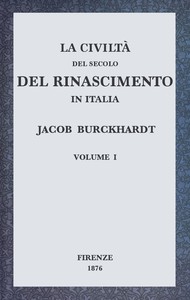
La civiltà del secolo del Rinascimento in Italia, Volume I by Jacob Burckhardt
Let's be clear: this isn't a novel. There's no single plot. Instead, think of Jacob Burckhardt's book as the ultimate guided tour through the Italian Renaissance mind. He doesn't just list facts; he builds a powerful argument about a cultural revolution.
The Story
Burckhardt's story is about a change in consciousness. He walks you through the crumbling medieval world of fixed social roles and collective identity. Then, he shows how, in the competitive city-states of Italy, everything fractured. The book is structured like a mosaic, examining different facets of this new life. One chapter shows you the ruthless, calculating princes (the 'state as a work of art'). Another plunges you into the rediscovery of the ancient world and the new focus on human potential. You see the glittering patronage that produced Michelangelo and Da Vinci, right alongside the poisonings and betrayals of courtly life. The final portrait is of the new 'Renaissance individual'—ambitious, self-reliant, often morally ambiguous, and obsessed with leaving a personal mark on the world.
Why You Should Read It
What grabbed me is how shockingly modern these 500-year-old people feel. Burckhardt makes you see the Renaissance not as a period of calm beauty, but as a tense, creative, and sometimes scary laboratory for the modern self. When you read about a condottiero (mercenary captain) carefully crafting his public image, or a scholar arguing for the dignity of man, you're seeing the roots of our own world. It makes you question: how much of our drive for personal brand, success, and recognition started in those Italian piazzas and palaces? It's a brilliant, connecting-the-dots kind of history that makes the past feel urgently relevant.
Final Verdict
This is for the curious reader who loves big ideas. Perfect for anyone who enjoyed books like Yuval Noah Harari's Sapiens but wants to go deeper into one transformative moment. It's not a light read—Burckhardt packs a lot in—but it's endlessly rewarding. If you've ever stood in front of a Renaissance painting and felt there was more to the story than just technique, this book gives you the key. It's the foundational text that taught us how to think about the Renaissance, and in many ways, about ourselves.
This text is dedicated to the public domain. You can copy, modify, and distribute it freely.
Logan Young
2 years agoWithout a doubt, it provides a comprehensive overview perfect for everyone. Highly recommended.
Amanda Gonzalez
1 year agoThanks for the recommendation.
Richard Flores
1 year agoGood quality content.
Donna Smith
1 year agoI came across this while browsing and the content flows smoothly from one chapter to the next. Truly inspiring.


Mary Sanchez
1 year agoNot bad at all.