About 84 minutes
The Man of Destiny — A Closer Reading
Adventure Picaresque Fiction
19,092 recorded words. 4 minutes difference from this book's estimate.
View Gutenberg source #4024
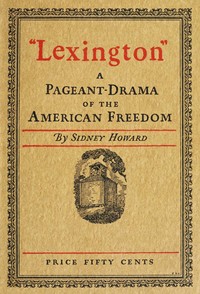
Before opening "Lexington": A Pageant-Drama of the American Freedom — Background and Themes, the edition data offers a quick orientation: 20,039 words, 1 hr 28 min estimated reading time, and 18 detected text sections.
The text analysis averages about 13.8 words per sentence, while the detected sections provide another way to judge how the source is divided.
Project Gutenberg metadata also associates the work with “Lexington, Battle of, Lexington, Mass., 1775 -- Drama,” connecting these edition facts with the source record’s subject description.
Explore this collection
These alternatives are selected using recorded categories and estimated reading time.
About 84 minutes
Adventure Picaresque Fiction
19,092 recorded words. 4 minutes difference from this book's estimate.
View Gutenberg source #4024About 92 minutes
Adventure Picaresque Fiction
21,139 recorded words. 4 minutes difference from this book's estimate.
View Gutenberg source #9068About 97 minutes
Adventure Picaresque Fiction
22,211 recorded words. 9 minutes difference from this book's estimate.
View Gutenberg source #22782Search stored excerpts and compare books → Choose by your preferences →
Choices use stored catalog measurements. Estimates vary with reading speed. A shared category is a catalog label, not a claim that two books have the same argument or literary quality.
Search reads excerpt text stored with this catalog and links to its associated Gutenberg record. The connection is stored in the site database; this tool does not recheck that every excerpt is word-for-word identical to that external record. Excerpt search does not cover every chapter and does not verify historical publication dates.
Catalog snapshot checked: 2026-09-26. Coverage: 90 public books, 90 available source excerpts.
Calculated from edition completeness, EPUB availability, text structure and catalogue metadata. Not a user rating.
Total of 100 points, scaled to a 2.5-5.0 range. Editions with an empty description or a missing EPUB file are not scored.
Public-domain source text
The source text is kept in the dedicated reader, separate from this catalogue record and its commentary.
Sidney Howard's Lexington: A Pageant-Drama of the American Freedom (1924) was written for a decennial outdoor performance by Lexington citizens, commemorating the 150th anniversary of the battle. The text is not a conventional play but a civic ritual: it employs a Chronicler, a Chorus, and an allegorical figure named Freedom who interacts with historical characters. The excerpts show that Howard weaves verbatim quotations from Washington's Farewell Address into the dialogue, while stage directions specify torchlight processions, singing of “Yankee Doodle,” and symbolic lighting shifts. This blend of documentary speech and pageantry creates a work that is part history lesson, part patriotic ceremony.
Howard places the allegorical figure Freedom onstage alongside historical actors such as Washington and Hamilton. In the excerpts, Freedom speaks directly to them, putting hands on their shoulders and looking into their eyes—a gesture that literalizes the abstract concept of liberty as a tangible presence. The Chronicler, a narrator figure, introduces each era with formal pronouncements: “The nation being established conceives the empire.” This triadic structure (allegorical figure, historical person, narrator) allows Howard to move between symbolic commentary and documented events without adhering to realistic drama. The effect is a staged meditation on national ideals rather than a plot-driven narrative.
The Chorus and Choir provide lyrical commentary, often quoting or adapting familiar songs. In Part Three, the Choir sings “Pioneers! O Pioneers!”—a direct reference to Walt Whitman’s poem, linking westward expansion to a literary tradition of manifest destiny. Stage directions specify a “soft, wild march theme” as Freedom evokes the Western migration. Howard uses music to cue emotional transitions: the scene of Washington’s inauguration ends with “the frantic joy of the crowd and much singing of ‘Yankee Doodle,’” then the stage darkens as the Chronicler speaks. These musical cues are integral to the pageant’s rhythm, shaping audience response without relying on naturalistic dialogue.
Howard incorporates extended passages from Washington’s Farewell Address, including warnings against “the baneful effects of the spirit of party” and “overgrown military establishments.” These are spoken by Washington as the stage directions indicate that the people stand “absolutely still and unresponsive” in shadow. By isolating Washington’s words in a moment of stillness, Howard treats the historical text as a dramatic monologue, emphasizing its gravity. The Chronicler frames these speeches as counsel: “The counsel is spoken. The farewell remains.” This technique transforms archival material into theatrical performance, asking the audience to hear familiar words anew within a staged context.
The stage directions in the excerpts are unusually detailed, specifying not only movement but also lighting and crowd behavior. For example, after Washington’s farewell, “Freedom puts her hands on the shoulders of Washington and Hamilton and looks into their eyes and the distant Chorus sings.” The scene ends with Freedom “last seen looking after them” as darkness takes the scene. These instructions create a choreographed, almost liturgical sequence. The pageant’s structure—with special nights dedicated to presidents, governors, and historical societies—further underscores its function as a community ritual. Howard’s directions treat the citizens of Lexington as performers, not just audience, reinforcing the pageant’s role in local commemorative practice.
Readers approaching this text should attend to its dual nature: it is both a script for performance and a document of early twentieth-century civic pageantry. Howard’s choices—allegorical figures, choral interludes, verbatim historical speeches—reveal an author working to make the past present through theatrical means. The excerpts offer only fragments of the full pageant, but they show a deliberate craft in blending documentary fidelity with symbolic staging. For those interested in how communities have dramatized national origins, this work provides a specific, localized example of that tradition.
I found Sidney Howard's Lexington pageant on a rainy afternoon, its choral voices and ritual scenes oddly moving in their earnestness. It made me think of another quiet drama I'd shelved nearby — one where enlightenment unfolds through dialogue rather than battle. Both feel like attempts to give form to inner awakenings, though one is public and the other profoundly still. The Buddha: A Drama in Five Acts and Four Interludes — Reading Companion stayed with me longer, perhaps because its silences spoke more gently.
Your answers remain private and are stored only in this browser.