About 30 minutes
Rada: A Drama of War in One Act — Context and Discussion
Adventure Picaresque Fiction
6,680 recorded words. 5 minutes difference from this book's estimate.
View Gutenberg source #12220
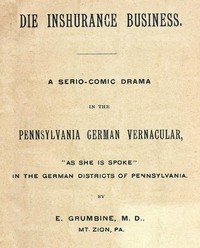
The source record for Die Inshurance Business A serio-comic drama in the Pennsylvania German vernacular, "as she is spoke" in the German districts of Pennsylvania — Key Ideas to Explore measures this digital text at 8,026 words, 35 min estimated reading time, and 2 detected text sections.
The text analysis averages about 11.4 words per sentence, while the detected sections provide another way to judge how the source is divided.
Project Gutenberg metadata also associates the work with “Pennsylvania German dialect -- Texts,” connecting these edition facts with the source record’s subject description.
Explore this collection
These alternatives are selected using recorded categories and estimated reading time.
About 30 minutes
Adventure Picaresque Fiction
6,680 recorded words. 5 minutes difference from this book's estimate.
View Gutenberg source #12220About 75 minutes
Adventure Picaresque Fiction
17,038 recorded words. 40 minutes difference from this book's estimate.
View Gutenberg source #3488About 75 minutes
Adventure Picaresque Fiction
17,215 recorded words. 40 minutes difference from this book's estimate.
View Gutenberg source #30584Search stored excerpts and compare books → Choose by your preferences →
Choices use stored catalog measurements. Estimates vary with reading speed. A shared category is a catalog label, not a claim that two books have the same argument or literary quality.
Search reads excerpt text stored with this catalog and links to its associated Gutenberg record. The connection is stored in the site database; this tool does not recheck that every excerpt is word-for-word identical to that external record. Excerpt search does not cover every chapter and does not verify historical publication dates.
Catalog snapshot checked: 2026-09-26. Coverage: 90 public books, 90 available source excerpts.
Calculated from edition completeness, EPUB availability, text structure and catalogue metadata. Not a user rating.
Total of 100 points, scaled to a 2.5-5.0 range. Editions with an empty description or a missing EPUB file are not scored.
Public-domain source text
The source text is kept in the dedicated reader, separate from this catalogue record and its commentary.
Ezra Grumbine's Die Inshurance Business (1880s) opens with a striking stage direction: Yokle Brownschweiger plaits a corn-husk mat while his wife Frany sews and their daughter Sallie crochets, the family engaged in quiet domestic labor. The dialogue immediately establishes the Pennsylvania German vernacular—"Hurry up Ike und mach die husk net so dick"—and a preoccupation with small sums: butter at 14 cents, eggs at 16, total $1.92. This precise economic grounding anchors the play's central conflict: a debt-ridden farm and an insurance scheme targeting the elderly Grandmother Aunshitz. Grumbine's stage directions specify costumes—Shwinefelt "loudly dressed" with a red necktie—and props like a spinning wheel, signaling a performance attuned to visual comedy.
The play is written entirely in Pennsylvania German, a dialect Grumbine's title describes as spoken "in the German districts of Pennsylvania." The dialogue mixes English loanwords—inshurance, shool-maishter, cheeografee—with German syntax, creating a hybrid that reflects the community's linguistic reality. Characters' speech reveals social roles: Yokle's practical concerns ("Wie feel hen die oyer und der butter g'macht?"), Sallie's emotional distress ("Sis gar nimmy in unsererm house we's war"), and Shwinefelt's slick patter. The stage directions also embed cultural details: plaiting corn husks, the daufshein (baptismal certificate) as a plot device, and the reference to "Lang Syne" through old neighbor Henner Hoffman. Grumbine uses the vernacular not merely for authenticity but as a vehicle for humor and tension—misunderstandings arise from Granny's deafness and the audience's familiarity with the dialect's nuances.
Grumbine controls pace by alternating static family scenes with bursts of action. Act I, Scene I is deliberately slow: Yokle plaiting, Frany sewing, Granny coughing and scraping an apple. The dialogue meanders through household finances and school supplies, establishing normalcy. Scene II shifts to a private conversation between Sallie and Gust, where the pace quickens with revelations—the altered baptismal certificate, the poison (later revealed as plaster of Paris), and Gust's inheritance of $10,000. The emotional rhythm accelerates: Sallie bursts into tears, wrings her hands, then cries on Gust's shoulder. Scene III returns to the family setting but introduces a suspenseful silent action: Shwinefelt empties a folded paper into Granny's teacup while Gust and Sallie witness it from the entrance. This tableau—two characters frozen at the door—creates a dramatic pause before the climax. The play's short scenes (three in Act I) and rapid entrances/exits maintain a theatrical momentum suited to its 35-minute reading time.
Grumbine's stage directions are unusually detailed for a vernacular drama, revealing character through physicality and costume. Yokle is introduced plaiting a corn-husk mat—a humble, repetitive task that underscores his economic straits. Shwinefelt's "loudly dressed" appearance—"large stand up collar with a red necktie, big cuffs"—marks him as an outsider, a city slicker preying on rural trust. Gust, by contrast, is "like a clerk, not quite so flashy," aligning him with respectability. Sallie is "the well dressed beauty of the play," a detail that positions her as the object of rivalry. The elderly Grandmother Aunshitz is described in a "huge white cap and spectacles," scraping an apple and coughing—a figure of vulnerability. These visual cues, combined with actions like Shwinefelt's surreptitious paper-emptying, build character without lengthy exposition. The play's moral landscape is thus sketched through objects and gestures: the teacup, the altered certificate, the plaster-filled poison packet.
Readers should attend to the play's performance dimension: the corn-husk plaiting, the coughing, the silent witnessing of Shwinefelt's act are all cues for comic or dramatic timing. The incomplete excerpts leave the resolution unclear—whether Gust's inheritance saves the farm, or whether Shwinefelt's scheme is exposed—but the structure suggests a swift denouement. Grumbine's work offers a rare record of Pennsylvania German dialect in dramatic form, where language itself becomes a character.
Years of shelving have taught me that Die Inshurance Business holds a quiet ache beneath its Pennsylvania German laughter—the cost of saving a farm, paid in family dignity. That same gentle discomfort lingers in Plays: Lady Frederick, The Explorer, A Man of Honour — Text and Context, where honor tussles with practical need. Both simply watch their people stumble toward a compromise, nothing more.
Build a private reading journal entry for this title.