About 75 minutes
Great Catherine (Whom Glory Still Adores) — A Reader’s Guide
Adventure Picaresque Fiction
17,038 recorded words. 0 minutes difference from this book's estimate.
View Gutenberg source #3488
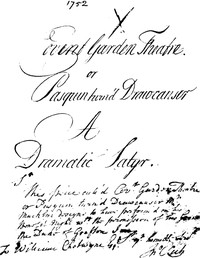
The Covent Garden Theatre, or Pasquin Turn'd Drawcansir — A Closer Reading can be approached with a clearer sense of reading commitment from its source measurements: 17,215 words, 1 hr 15 min estimated reading time, and 3 detected text sections.
The text analysis averages about 18.4 words per sentence, while the detected sections provide another way to judge how the source is divided.
Project Gutenberg metadata also associates the work with “English drama,” connecting these edition facts with the source record’s subject description.
Explore this collection
These alternatives are selected using recorded categories and estimated reading time.
About 75 minutes
Adventure Picaresque Fiction
17,038 recorded words. 0 minutes difference from this book's estimate.
View Gutenberg source #3488About 84 minutes
Adventure Picaresque Fiction
19,092 recorded words. 9 minutes difference from this book's estimate.
View Gutenberg source #4024About 88 minutes
Adventure Picaresque Fiction
20,039 recorded words. 13 minutes difference from this book's estimate.
View Gutenberg source #65048Search stored excerpts and compare books → Choose by your preferences →
Choices use stored catalog measurements. Estimates vary with reading speed. A shared category is a catalog label, not a claim that two books have the same argument or literary quality.
Search reads excerpt text stored with this catalog and links to its associated Gutenberg record. The connection is stored in the site database; this tool does not recheck that every excerpt is word-for-word identical to that external record. Excerpt search does not cover every chapter and does not verify historical publication dates.
Catalog snapshot checked: 2026-09-26. Coverage: 90 public books, 90 available source excerpts.
Calculated from edition completeness, EPUB availability, text structure and catalogue metadata. Not a user rating.
Total of 100 points, scaled to a 2.5-5.0 range. Editions with an empty description or a missing EPUB file are not scored.
Public-domain source text
The source text is kept in the dedicated reader, separate from this catalogue record and its commentary.
The manuscript of The Covent Garden Theatre, or Pasquin Turn'd Drawcansir begins not with a scene but with a paratextual apparatus that immediately signals its hybrid nature: part play, part document. The title page presents Pasquin—a name borrowed from the Roman pasquinades—as transformed into Drawcansir, a character from Buckingham's The Rehearsal. This double allusion primes readers for satire aimed at both theatrical fashion and moral censorship. The opening pages, including the Augustan Reprint Society's introduction, establish that the text is a facsimile of a handwritten copy, likely by a professional scribe, with line-endings regularized by added dashes. Readers encounter these editorial notes before any dialogue, a framing that foregrounds the play's status as a historical artifact rather than a polished performance text.
The first excerpt plunges the reader into a mock trial before Pasquin, styled as "Censor of Great Britain." The dialogue crackles with double entendres and social critique. Lady Lucy Loveit, arrested en route to a masquerade, is accused of indecency for her "very short Pet: en l'air" and bare neck. Sir Roger's bawdy wager—"I'll hold a Hogshead of Claret to a Gill, she pleases more than the Ostrich"—anchors the satire in contemporary stage rivalries, likely referencing the real Ostrich act at Covent Garden. Pasquin's role as judge is complicated by his own theatrical past: he performed at the Italian Theatre in Paris. This layered identity invites readers to question whether he is a genuine censor or a showman exploiting scandal for profit.
Macklin populates his courtroom with a gallery of types, each announced by name and exaggerated speech. Sir Roger Eternal, Sir Rogert Marfario, and Miss Giggle are less characters than walking vices. Lady Lucy's entrance—masked, dressed for the masquerade, and immediately recognized by Hydra—blurs the line between public performance and private identity. Her line "I am dress'd for the Masquerade" underscores the play's central conceit: all the world is a stage, and the courtroom is merely another scene. The rapid-fire exchanges, with characters interrupting and overlapping, mimic the chaos of a real theatre pit. Readers should note how Macklin uses names as shorthand: Hydra suggests a many-headed monster of gossip, while Marfario echoes the commedia dell'arte figure who delivers false news.
The text itself bears witness to its own production. The transcriber's notes alert readers to missing pages (60–61), uncertain readings, and corrections by the original writer or the Examiner of Plays. These marks of censorship and revision are not mere footnotes; they are part of the play's meaning. The fact that the manuscript was submitted to the Examiner—and that some passages were altered or struck—suggests that Macklin's satire trod close to the line of permissible critique. Readers encountering the text in facsimile must navigate these material layers: the handwritten original, the editorial interventions, and the modern transcription. The play's content—a satire on theatrical regulation—thus becomes mirrored in its own history of regulation.
One of the most distinctive features of this edition is the regularization of line-endings by added dashes. The editors note that "some 'real' dashes are therefore conjectural." This ambiguity forces readers to attend to punctuation as a site of interpretation. When Lady Lucy exclaims "O you fulsome Creature [she unmasks] from what Antiquated Romance did you Steal that vile Compliment," the dash after "Creature" may be original or editorial. Such details matter because they affect rhythm and tone. The play's humor depends on timing—the rapid volleys of repartee, the pauses for laughter. A conjectural dash can alter a punchline. First-time readers are advised to read aloud, testing the dashes as potential breaths or beats, and to consult the page images when in doubt.
This edition rewards a slow, attentive reading that moves between the dialogue and its material frame. The play's satire is pointed but not obscure; its targets—fashionable vice, theatrical hypocrisy, and censorship—remain legible. What may disorient is the manuscript's unfinished quality: missing pages, uncertain readings, and the sense of a work caught between performance and print. Treat these gaps not as defects but as invitations to imagine the play in its original context, where every dash and correction tells a story of eighteenth-century stage politics.
Reading the editorial note on Macklin’s manuscript, I was struck by how carefully its framing shaped my first impressions—that gentle guidance through satire and ambiguity felt familiar. It reminded me of another collection’s careful context, where character introductions and textual notes similarly softened the edges of uncertainty. I found myself thinking of Plays: Lady Frederick, The Explorer, A Man of Honour — Text and Context late that evening, a quiet echo of the same patient hand.
Answer a few questions and save a private reflection on this device.