About 605 minutes
A Select Collection of Old English Plays, Volume 10 — Reading Companion
Adventure Picaresque Fiction
139,025 recorded words. 1 minutes difference from this book's estimate.
View Gutenberg source #46412
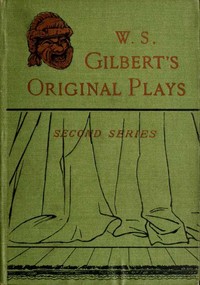
This digital edition of Original Plays, Second Series — Inside the Classic is described by source-level measurements including 138,847 words, 10 hr 4 min estimated reading time, and 18 detected text sections.
The text analysis averages about 9.8 words per sentence, while the detected sections provide another way to judge how the source is divided.
Project Gutenberg metadata also associates the work with “Operas -- Librettos,” connecting these edition facts with the source record’s subject description.
Explore this collection
These alternatives are selected using recorded categories and estimated reading time.
About 605 minutes
Adventure Picaresque Fiction
139,025 recorded words. 1 minutes difference from this book's estimate.
View Gutenberg source #46412About 672 minutes
Adventure Picaresque Fiction
154,449 recorded words. 68 minutes difference from this book's estimate.
View Gutenberg source #15081About 466 minutes
Adventure Picaresque Fiction
107,047 recorded words. 138 minutes difference from this book's estimate.
View Gutenberg source #10656Search stored excerpts and compare books → Choose by your preferences →
Choices use stored catalog measurements. Estimates vary with reading speed. A shared category is a catalog label, not a claim that two books have the same argument or literary quality.
Search reads excerpt text stored with this catalog and links to its associated Gutenberg record. The connection is stored in the site database; this tool does not recheck that every excerpt is word-for-word identical to that external record. Excerpt search does not cover every chapter and does not verify historical publication dates.
Catalog snapshot checked: 2026-09-26. Coverage: 90 public books, 90 available source excerpts.
Calculated from edition completeness, EPUB availability, text structure and catalogue metadata. Not a user rating.
Total of 100 points, scaled to a 2.5-5.0 range. Editions with an empty description or a missing EPUB file are not scored.
Public-domain source text
The source text is kept in the dedicated reader, separate from this catalogue record and its commentary.
W. S. Gilbert's Original Plays, Second Series collects nine works that span the range of his dramatic output, from the fairy-tale melancholy of Broken Hearts to the nautical comedy of H.M.S. Pinafore. The volume reveals a playwright who delights in toying with identity and social convention. In Tom Cobb; or, Fortune's Toy, a financially desperate man named Tom Cobb schemes to fake his own death by assuming the identity of a deceased pauper who shares his name—a plot that hinges on the absurd precision of a shared moniker. Gilbert's dialogue crackles with ironic reversals: a character who declares he would 'blow his brains out' is immediately offered a 'safe and perfectly painless' alternative. The collection also includes the libretti for three of Gilbert and Sullivan's most enduring comic operas, showing the same verbal dexterity applied to musical theatre.
Throughout the plays in this volume, money troubles drive the plot with a relentless, almost farcical urgency. In Tom Cobb, the protagonist's debts to 'Ben Isaacs' lead him to embrace a scheme of 'dying by deputy.' The dialogue repeatedly circles back to the lack of funds: Tom laments that he cannot afford 'a pair of trousers or half a dozen socks,' and his friend Whipple, when asked for a loan, offers a 'plain answer' but no money. The pattern recurs in Engaged, where financial considerations complicate romantic proposals, and in The Sorcerer, where a love potion disrupts social order. Gilbert treats poverty not as a tragic condition but as a springboard for verbal and situational comedy. Characters negotiate debts with the same gravity they apply to matters of the heart, and the threat of ruin is always undercut by a punchline.
Gilbert repeatedly explores the idea that identity can be swapped, borrowed, or faked. In Tom Cobb, the protagonist literally becomes a dead man to escape his creditors. The play's premise—that two men share the same name, one living and one dead—allows for a legal fiction that Gilbert exploits for both humor and suspense. Similarly, H.M.S. Pinafore hinges on the revelation that a lowly sailor is actually of noble birth, while The Pirates of Penzance plays with the absurdity of a 'slave of duty' whose very identity is bound by a mistaken apprenticeship. In Broken Hearts, the setting itself—the 'Island of Broken Hearts'—suggests a world where emotional states define character. Gilbert's characters often adopt new names or roles with startling ease, suggesting that identity is less a fixed essence than a convenient fiction.
The volume juxtaposes two modes: the tightly plotted farce and the whimsical fairy play. Broken Hearts is subtitled 'An Entirely Original Fairy Play' and is set in a tropical landscape with a dwarf named Mousta, while Tom Cobb is a three-act farce driven by mistaken identity and rapid exits. Yet both share Gilbert's signature structure: a premise that is logically absurd is pursued with relentless, almost legalistic rigor. In Tom Cobb, the plan to 'die by deputy' is explained step by step, complete with burial fees and a certificate of death. In The Sorcerer, a love potion creates chaos by making everyone fall in love with the first person they see—a rule applied with mechanical precision. Gilbert's plays often feel like mathematical proofs applied to human folly, where the emotional stakes are high but the tone remains coolly ironic.
Readers approaching this collection will find that Gilbert's plays reward attention to his verbal craftsmanship. The dialogue is dense with puns, inversions, and comic timing that can be appreciated on the page as much as on the stage. Because the volume includes both straight plays and libretti, it offers a chance to compare how Gilbert adapts his style to different forms. The plays are best read with an ear for rhythm and a tolerance for contrivance—the pleasure lies not in realism but in the elegant machinery of the plot.
There's a bittersweet ache in rereading Original Plays, Second Series, especially watching Gilbert's clever schemers get tangled in their own romantic nets. It reminds me of eighteenth-century Genoa, where Schiller's conspiracies unravel with the same quiet inevitability. That feeling of fate closing in—whether through a comic misunderstanding or a political plot—stays with you, oddly comforting. I find myself thinking of Fiesco; or, the Genoese Conspiracy: A Tragedy — Story, Setting & Ideas lately, like an old friend’s face in a crowd.
Save your reaction, strongest insight, and memorable passage.