About 604 minutes
Original Plays, Second Series — Inside the Classic
Adventure Picaresque Fiction
138,847 recorded words. 1 minutes difference from this book's estimate.
View Gutenberg source #59685
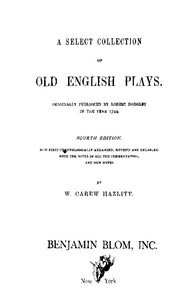
The source record for A Select Collection of Old English Plays, Volume 10 — Reading Companion measures this digital text at 139,025 words, 10 hr 5 min estimated reading time, and 34 detected text sections.
The text analysis averages about 14.2 words per sentence, while the detected sections provide another way to judge how the source is divided.
Project Gutenberg metadata also associates the work with “English drama,” connecting these edition facts with the source record’s subject description.
Explore this collection
These alternatives are selected using recorded categories and estimated reading time.
About 604 minutes
Adventure Picaresque Fiction
138,847 recorded words. 1 minutes difference from this book's estimate.
View Gutenberg source #59685About 672 minutes
Adventure Picaresque Fiction
154,449 recorded words. 67 minutes difference from this book's estimate.
View Gutenberg source #15081About 466 minutes
Adventure Picaresque Fiction
107,047 recorded words. 139 minutes difference from this book's estimate.
View Gutenberg source #10656Search stored excerpts and compare books → Choose by your preferences →
Choices use stored catalog measurements. Estimates vary with reading speed. A shared category is a catalog label, not a claim that two books have the same argument or literary quality.
Search reads excerpt text stored with this catalog and links to its associated Gutenberg record. The connection is stored in the site database; this tool does not recheck that every excerpt is word-for-word identical to that external record. Excerpt search does not cover every chapter and does not verify historical publication dates.
Catalog snapshot checked: 2026-09-26. Coverage: 90 public books, 90 available source excerpts.
Calculated from edition completeness, EPUB availability, text structure and catalogue metadata. Not a user rating.
Total of 100 points, scaled to a 2.5-5.0 range. Editions with an empty description or a missing EPUB file are not scored.
Public-domain source text
The source text is kept in the dedicated reader, separate from this catalogue record and its commentary.
The tenth volume of Dodsley's Select Collection opens with Cyril Tourneur's The Revenger's Tragedy, a play that the editor W. Carew Hazlitt introduces with a brief biographical note—remarking that Tourneur's contemporary fame was such that he was 'not to be despis'd, nor over-prais'd.' The editorial apparatus is dense: footnotes trace variant readings across early quartos, gloss obscure terms like 'garboils' and 'quirks,' and cite sources from Shakespeare to Lyly. One manuscript note, quoted in the introduction, calls the play 'a most splendid work' whose protagonist 'surpasses anything else of the kind.'
The excerpts show Hazlitt's method of collating early editions. For instance, a footnote on The Revenger's Tragedy records that the 1607 and 1608 quartos both read 'retires,' but the editor suggests it might mean 'draw back' rather than 'withdraw.' Another note corrects a misreading of 'studient' to 'studient,' arguing the form is 'legitimate, though uncommon.' These annotations reveal a scholarly concern with recovering the playwright's original wording, even when the meter or sense is ambiguous.
Hazlitt also engages with earlier commentators: he quotes Collier on the inferiority of The Atheist's Tragedy and disputes a claim by the Rev. Mr. Todd about the word 'garboil,' pointing out that Bishop Hall was satirizing Stanihurst's translation, not using the word himself. Such cross-references build a layered editorial conversation across centuries.
In the excerpt from The Revenger's Tragedy (Act II, Scene 1), the dialogue between Oliver Small-Shanks and his son Thomas is laced with sexual innuendo. Oliver boasts of his youthful prowess: 'I could have ferk'd, and ferk'd y' away a wench, / As soon as e'er a man alive.' The language is earthy and energetic, with terms like 'conveyance,' 'quirks,' and 'ferk'd' carrying double meanings. The scene introduces a stolen heiress, Frances, whom William Small-Shanks calls 'wench of gold,' planning to use her 'bare gettings' to purchase land. This subplot contrasts sharply with the revenge tragedy's main action, offering a comic, mercenary counterpoint.
The footnotes gloss 'ferk'd' as a form of 'prick' and explain 'quirks' as 'subtleties,' citing Lyly's Euphues. The editorial attention to these bawdy passages underscores their linguistic richness and the period's tolerance for explicit wordplay.
The Project Gutenberg record classifies this volume under 'Adventure & Picaresque Fiction' and 'English drama,' but the excerpts reveal a work that is primarily scholarly and editorial. The bulk of the text consists of introductions, footnotes, and collations—not the plays themselves. The 'Adventure' tag may derive from the revenge plot of The Revenger's Tragedy, but the excerpts emphasize textual criticism over narrative action.
Moreover, the bawdy subplot and the editor's focus on linguistic curiosities (e.g., 'garboils,' 'studient') suggest a readership interested in philology and early modern stage conventions. The volume is less a collection of adventure tales than a critical edition for specialists, with Hazlitt's notes forming a substantial part of the reading experience.
Readers approaching this volume should expect a scholarly apparatus that sometimes overshadows the plays themselves. Hazlitt's footnotes reward careful attention, as they illuminate the textual history and linguistic texture of early 17th-century drama. The bawdy subplot in The Revenger's Tragedy offers a vivid example of the period's comic register, but the volume's primary value lies in its editorial reconstruction of lost or variant readings.
There’s something tender about old playbooks—the footnotes fussing over lost words, the bawdy plotlines tucked beside grim ones. I often think of that while settling in with a holiday anthology, where mischief softens into warmth. The White Christmas and other Merry Christmas Plays — Story, Setting & Ideas feels like that same quiet shelf, holding gentler echoes of old stages. Just a wistful nod between cousins.
Answer a few questions and save a private reflection on this device.