About 27 minutes
Mosada: A dramatic poem — Reading Companion
Science Fiction Utopias
6,062 recorded words. 20 minutes difference from this book's estimate.
View Gutenberg source #33430
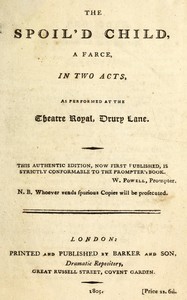
The source record for The spoil'd child: A farce, in two acts, as performed at the Theatre Royal, Drury Lane — Text and Context measures this digital text at 10,771 words, 47 min estimated reading time, and 5 detected text sections.
The text analysis averages about 20.6 words per sentence, while the detected sections provide another way to judge how the source is divided.
Project Gutenberg metadata also associates the work with “English drama -- 18th century,” connecting these edition facts with the source record’s subject description.
Explore this collection
These alternatives are selected using recorded categories and estimated reading time.
About 27 minutes
Science Fiction Utopias
6,062 recorded words. 20 minutes difference from this book's estimate.
View Gutenberg source #33430About 83 minutes
Science Fiction Utopias
19,081 recorded words. 36 minutes difference from this book's estimate.
View Gutenberg source #2543About 84 minutes
Science Fiction Utopias
19,093 recorded words. 37 minutes difference from this book's estimate.
View Gutenberg source #11633Search stored excerpts and compare books → Choose by your preferences →
Choices use stored catalog measurements. Estimates vary with reading speed. A shared category is a catalog label, not a claim that two books have the same argument or literary quality.
Search reads excerpt text stored with this catalog and links to its associated Gutenberg record. The connection is stored in the site database; this tool does not recheck that every excerpt is word-for-word identical to that external record. Excerpt search does not cover every chapter and does not verify historical publication dates.
Catalog snapshot checked: 2026-09-26. Coverage: 90 public books, 90 available source excerpts.
Calculated from edition completeness, EPUB availability, text structure and catalogue metadata. Not a user rating.
Total of 100 points, scaled to a 2.5-5.0 range. Editions with an empty description or a missing EPUB file are not scored.
Public-domain source text
The source text is kept in the dedicated reader, separate from this catalogue record and its commentary.
The prologue, spoken by Mrs. Jordan, immediately establishes a self-conscious theatricality. She enters reading a letter from a desperate author, then directly addresses the audience: “You’re all spoilt children of a larger growth.” This meta-theatrical framing, combined with the play’s subtitle “A Farce, in Two Acts,” signals that the work will use exaggerated situations and quick-paced dialogue to critique indulgence. The prologue’s playful tone—mocking both playwrights and spectators—sets the stage for a comedy that delights in its own artifice.
The dialogue relies heavily on exclamations and rhythmic patterns that mimic spoken farce. Characters frequently break into interjections like “ha! ha! ha!” or “egad,” and the text is punctuated with dashes and repeated phrases. For instance, Old Pickle’s repeated “yeo, yeo, yeo” becomes a verbal tic that underscores his agitation. The prose often shifts into near-verse, as when Maria declares, “The generous youth shall own, I love him for himself alone.” This blend of colloquial outbursts and stilted declarations creates a distinct vocal texture that propels the action forward without pausing for naturalistic reflection.
The two-act structure is built around a series of escalating tricks. Little Pickle, after revealing his identity, immediately proposes a new deception: “Suppose you pretend to fall in love with me, and we run away together.” Each scene introduces a fresh plot—from the initial nurse-switch to the threatened arson (“suppose I set the house on fire—no—no—’tis too soon for that as yet”). This rapid succession of schemes, often hatched and executed within the same scene, maintains a breathless pace. The play’s brevity (under 11,000 words) ensures that no single joke overstays its welcome, and the constant invention keeps the audience engaged.
The prologue’s meta-theatricality extends into the play itself. Characters acknowledge their own performances: Little Pickle refers to his “scheme” and “trick,” while Maria adopts a “romantically” exaggerated tone. Old Pickle’s aside, “What, poetry too—nay then, it is time to prevent further mischief,” directly comments on the artificiality of the lovers’ dialogue. This self-awareness aligns with the farce tradition of winking at the audience, reminding them that the chaos on stage is a deliberate construction. The play’s closing lines, though not fully excerpted, likely reinforce this playful contract between performer and spectator.
Readers approaching this farce should attend to its verbal energy and structural economy. The dialogue rewards attention to rhythm and repetition, while the rapid succession of pranks creates a cumulative comic effect. The play’s self-consciousness—its awareness of being a performance—invites a reading that appreciates both the surface humor and the underlying critique of spoiled behavior. For those interested in eighteenth-century theatre, this edition offers a glimpse into the popular farce tradition at Drury Lane.
Reading the gleeful chaos of Little Pickle, I thought of my father’s laugh—bright and sudden—when we’d act out scenes at home. Later, Plays — Reading Notes stirred that same warmth, its margins holding someone’s quiet joy in mischief. Plays — Reading Notes feels like an old friend’s handwriting, not a lesson, just a shared fondness for foolishness. That tenderness lingers here.
Your answers remain private and are stored only in this browser.