About 366 minutes
The Growth of English Drama — Themes and Context
Science Fiction Utopias
84,017 recorded words. 11 minutes difference from this book's estimate.
View Gutenberg source #18799
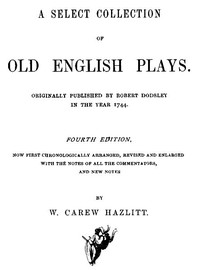
This digital edition of A Select Collection of Old English Plays, Volume 03 — Text and Context is described by source-level measurements including 86,495 words, 6 hr 17 min estimated reading time, and 18 detected text sections.
The text analysis averages about 15.9 words per sentence, while the detected sections provide another way to judge how the source is divided.
Project Gutenberg metadata also associates the work with “English drama,” connecting these edition facts with the source record’s subject description.
Explore this collection
These alternatives are selected using recorded categories and estimated reading time.
About 366 minutes
Science Fiction Utopias
84,017 recorded words. 11 minutes difference from this book's estimate.
View Gutenberg source #18799About 347 minutes
Science Fiction Utopias
79,613 recorded words. 30 minutes difference from this book's estimate.
View Gutenberg source #45794About 322 minutes
Science Fiction Utopias
74,039 recorded words. 55 minutes difference from this book's estimate.
View Gutenberg source #58546Search stored excerpts and compare books → Choose by your preferences →
Choices use stored catalog measurements. Estimates vary with reading speed. A shared category is a catalog label, not a claim that two books have the same argument or literary quality.
Search reads excerpt text stored with this catalog and links to its associated Gutenberg record. The connection is stored in the site database; this tool does not recheck that every excerpt is word-for-word identical to that external record. Excerpt search does not cover every chapter and does not verify historical publication dates.
Catalog snapshot checked: 2026-09-26. Coverage: 90 public books, 90 available source excerpts.
Calculated from edition completeness, EPUB availability, text structure and catalogue metadata. Not a user rating.
Total of 100 points, scaled to a 2.5-5.0 range. Editions with an empty description or a missing EPUB file are not scored.
Public-domain source text
The source text is kept in the dedicated reader, separate from this catalogue record and its commentary.
The four plays in this volume—New Custom, Ralph Roister Doister, Gammer Gurton's Needle, and Like Will to Like—offer a cross-section of mid-sixteenth-century English drama, from allegorical morality to farcical comedy. Hazlitt's edition preserves the original stage directions, prologues, and cast lists, which reveal how these works were designed for small troupes: New Custom is explicitly arranged so that four actors can play all roles, a practical constraint that shapes its dialogue-heavy scenes and rapid character shifts.
New Custom opens with a prologue warning that appearances deceive—a theme reinforced by its casting scheme. The play's list of ten characters is compressed into four actors, each taking multiple parts: the same performer plays both the villainous Perverse Doctrine and the virtuous Edification. This doubling forces the audience to rely on verbal cues and costume changes rather than physical distinction, making the moral allegory a test of recognition. Similarly, Gammer Gurton's Needle uses a small cast to generate comic chaos; the servant Hodge narrates the central dispute in a repetitive, almost chant-like speech ("see now") that mimics oral storytelling. The plays' structures thus reflect both economic necessity and a deliberate theatricality that rewards attentive listening.
A lost object drives the plot in two plays: the needle in Gammer Gurton's Needle and, implicitly, the "treasure" in The Trial of Treasure. In the former, the needle's disappearance triggers a cascade of accusations, physical fights, and a mock-trial led by the bumbling Doctor Rat. The object itself is trivial—a sewing needle—but its loss exposes the fragility of social order in a small village. Characters repeatedly describe the needle as "lost" and "found," yet no one ever sees it recovered onstage; the resolution comes through a farcical beating rather than discovery. This pattern of loss without clear restitution recurs in Like Will to Like, where the prodigal characters squander their inheritances and are left with nothing but moral admonishment.
The plays shift rapidly between domestic interiors, street scenes, and allegorical landscapes. Gammer Gurton's Needle is set almost entirely at Gammer Gurton's door, where neighbors gather, argue, and eavesdrop. The threshold becomes a stage within the stage, a liminal space where private disputes become public spectacles. In contrast, New Custom moves between abstract locations—the "House of Perverse Doctrine" and the "School of Light of the Gospel"—using dialogue to signal changes in moral geography. Ralph Roister Doister employs a more urban setting, with characters entering and exiting from multiple houses, creating a sense of bustling community. These spatial transitions are rarely marked by elaborate scenery; instead, the text relies on verbal announcements and character entrances to orient the audience.
Dialect and idiolect distinguish characters across the collection. In Gammer Gurton's Needle, Gammer Gurton speaks in a thick rural dialect ("'ch a lost my good nee'le"), while Doctor Rat uses a more formal, Latinate register. The contrast heightens the comedy of miscommunication: the doctor's pomposity is deflated by the gammer's earthy complaints. New Custom employs allegorical names—Perverse Doctrine, Hypocrisy, Light of the Gospel—that telegraph each character's moral stance, but their speech patterns also vary: Hypocrisy speaks in flattering, indirect phrases, while New Custom uses direct, declarative sentences. Ralph Roister Doister features a braggart soldier whose bombastic rhetoric is undercut by his cowardice, a verbal pattern that anticipates later comic types. These linguistic choices give each play a distinct auditory texture, even when the plots share similar motifs.
Readers approaching this volume will benefit from reading the prologues and cast lists first, as they establish the theatrical conventions that shape each play. Pay attention to how characters enter and exit—these movements often signal shifts in tone or moral argument. The plays reward repeated readings: what seems like simple farce in Gammer Gurton's Needle reveals a sharp critique of village authority, while the allegories in New Custom gain complexity when considered alongside the practical constraints of performance.
I keep thinking of that old collection, how Gammer Gurton's muddle of a missing needle felt so much like a quiet little war over nothing. It made me recall the fussier, more polished deceptions in Cynthia's Revels, where the masks feel heavier, and self-love turns the whole court into a mirror. Somehow, both left me with the same gentle ache for simpler, clumsier truths. Cynthia's Revels; Or, The Fountain of Self-Love — Reading Notes sits nearby now, a bright companion to that old, worn volume.
Build a private reading journal entry for this title.