About 366 minutes
The Growth of English Drama — Themes and Context
Science Fiction Utopias
84,017 recorded words. 19 minutes difference from this book's estimate.
View Gutenberg source #18799
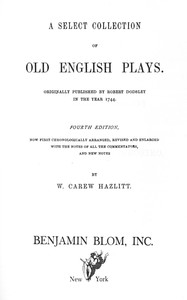
The catalog record for A Select Collection of Old English Plays, Volume 05 — Story, Setting & Ideas provides practical reading context through 79,613 words, 5 hr 47 min estimated reading time, and 23 detected text sections.
The text analysis averages about 17.2 words per sentence, while the detected sections provide another way to judge how the source is divided.
Project Gutenberg metadata also associates the work with “English drama,” connecting these edition facts with the source record’s subject description.
Explore this collection
These alternatives are selected using recorded categories and estimated reading time.
About 366 minutes
Science Fiction Utopias
84,017 recorded words. 19 minutes difference from this book's estimate.
View Gutenberg source #18799About 322 minutes
Science Fiction Utopias
74,039 recorded words. 25 minutes difference from this book's estimate.
View Gutenberg source #58546About 377 minutes
Science Fiction Utopias
86,495 recorded words. 30 minutes difference from this book's estimate.
View Gutenberg source #47170Search stored excerpts and compare books → Choose by your preferences →
Choices use stored catalog measurements. Estimates vary with reading speed. A shared category is a catalog label, not a claim that two books have the same argument or literary quality.
Search reads excerpt text stored with this catalog and links to its associated Gutenberg record. The connection is stored in the site database; this tool does not recheck that every excerpt is word-for-word identical to that external record. Excerpt search does not cover every chapter and does not verify historical publication dates.
Catalog snapshot checked: 2026-09-26. Coverage: 90 public books, 90 available source excerpts.
Calculated from edition completeness, EPUB availability, text structure and catalogue metadata. Not a user rating.
Total of 100 points, scaled to a 2.5-5.0 range. Editions with an empty description or a missing EPUB file are not scored.
Public-domain source text
The source text is kept in the dedicated reader, separate from this catalogue record and its commentary.
Thomas Kyd's The Spanish Tragedy, the first play in this volume, opens with the Ghost of Andrea and Revenge, a framing device that immediately establishes a tone of supernatural retribution. The dialogue in the excerpted scenes is marked by rapid, stichomythic exchanges—short, sharp lines that heighten emotional tension. For instance, Cornelia's replies to Philip are often single lines or couplets, creating a rhythm of defiance and despair. The play's language is dense with rhetorical questions and classical allusions, such as Cornelia's reference to 'Cæsar's death' as a medicine for her grief. This editorial note examines how Kyd's diction and dialogue structure convey psychological states and thematic concerns.
In the excerpt from Cornelia, Kyd employs stichomythia—alternating single lines of dialogue—to dramatize a clash of wills between Cornelia and Philip. Philip counsels caution: 'Madam, beware; for, should he hear of this, / His wrath against you 'twill exasperate.' Cornelia retorts with defiance: 'I neither stand in fear of him nor his.' This rapid back-and-forth accelerates the pace and underscores Cornelia's unyielding grief. The technique recurs throughout the volume, particularly in moments of high emotion. Kyd uses it not merely as a stylistic flourish but as a tool to reveal character: Cornelia's lines are shorter, more abrupt, reflecting her agitation, while Philip's are more measured. The effect is a verbal duel that mirrors the political and personal conflicts of the play.
Cornelia's speeches are punctuated by rhetorical questions that amplify her despair. She asks, 'Can nothing then recure these endless tears?' and later, 'What can he do?' These questions are not requests for information but expressions of hopelessness. Philip's response—'Madam, what cannot men, / That have the power to do what pleaseth them?'—turns her question back on her, highlighting the asymmetry of power. Kyd's use of rhetorical questions creates a sense of futility; Cornelia's grief is presented as unassailable, impervious to reason. This technique is consistent with the play's exploration of tyranny and suffering, where language becomes a vehicle for lament rather than resolution.
Kyd weaves classical references into the dialogue, grounding the personal tragedy in a broader historical context. Cornelia invokes 'Pompey' and 'Cæsar,' linking her own sorrow to the fall of Rome. The Chorus, speaking in a different meter, delivers a moralizing reflection on Fortune: 'Fortune in power imperious / Us'd o'er the world and worldlings thus / To tyrannise.' This choral passage employs a series of similes—Fortune's feet 'more swift than is the wind'—and catalogues historical figures like Marius and Pompey to illustrate Fortune's fickleness. The shift from dialogue to choral verse marks a change in register, from personal anguish to philosophical commentary. Kyd's integration of classical learning into the vernacular drama was typical of the period, but here it serves to elevate the play's themes of ambition and downfall.
The vocabulary in the excerpts repeatedly circles around tyranny and resistance. Cornelia uses words like 'tyrannise,' 'torment,' and 'torture,' while Philip speaks of 'policy' and 'power.' The line 'There is nothing in the soul of man / So firmly grounded, as can qualify / Th' inextinguishable thirst of signiory' encapsulates the play's critique of ambition. Kyd's diction is deliberately heightened, with Latinate terms ('signiory,' 'exasperate') that lend a formal, almost legalistic tone. This lexical choice reinforces the theme of political oppression: language itself becomes a site of struggle. Cornelia's defiance is expressed through a refusal to be silenced—'He can do me no mischief that I dread'—even as she acknowledges the possibility of 'rigorous torments.' The interplay of fear and courage is rendered through precise word choices that reward close reading.
Readers approaching this volume should attend to the interplay between dialogue and choral commentary, as Kyd uses both to explore the limits of human agency. The stichomythic exchanges and rhetorical questions are not mere ornament but structural devices that convey emotional and political tensions. By focusing on the authorial choices in diction and structure, one can appreciate how these early modern plays use language to dramatize the conflict between individual will and external forces like fortune or tyranny.
Reading Kyd's lines on Fortune's fickleness felt like watching leaves turn in a restless wind, and it quietly brought to mind The Piccolomini—the way Schiller let his characters circle the same fateful uncertainty, their griefs unfolding at their own pace. There is a comfort in that echo, as if old plays whisper to each other across centuries, sharing the same patient sorrow. The Piccolomini: A Play — Edition Insights rests beside them on my shelf, a familiar hand resting on a worn spine.
Save your reaction, strongest insight, and memorable passage.