About 672 minutes
The Tragedies of Euripides, Volume I. — Reading Companion
Adventure Picaresque Fiction
154,449 recorded words. 468 minutes difference from this book's estimate.
View Gutenberg source #15081
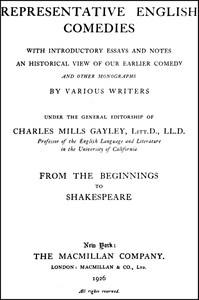
This digital edition of Representative English Comedies, v. 1. From the beginnings to Shakespeare — A Closer Reading is described by source-level measurements including 262,199 words, 19 hr estimated reading time, and 49 detected text sections.
The text analysis averages about 16.1 words per sentence, while the detected sections provide another way to judge how the source is divided.
Project Gutenberg metadata also associates the work with “English drama (Comedy),” connecting these edition facts with the source record’s subject description.
Explore this collection
These alternatives are selected using recorded categories and estimated reading time.
About 672 minutes
Adventure Picaresque Fiction
154,449 recorded words. 468 minutes difference from this book's estimate.
View Gutenberg source #15081About 605 minutes
Adventure Picaresque Fiction
139,025 recorded words. 535 minutes difference from this book's estimate.
View Gutenberg source #46412About 604 minutes
Adventure Picaresque Fiction
138,847 recorded words. 536 minutes difference from this book's estimate.
View Gutenberg source #59685Search stored excerpts and compare books → Choose by your preferences →
Choices use stored catalog measurements. Estimates vary with reading speed. A shared category is a catalog label, not a claim that two books have the same argument or literary quality.
Search reads excerpt text stored with this catalog and links to its associated Gutenberg record. The connection is stored in the site database; this tool does not recheck that every excerpt is word-for-word identical to that external record. Excerpt search does not cover every chapter and does not verify historical publication dates.
Catalog snapshot checked: 2026-09-26. Coverage: 90 public books, 90 available source excerpts.
Calculated from edition completeness, EPUB availability, text structure and catalogue metadata. Not a user rating.
Total of 100 points, scaled to a 2.5-5.0 range. Editions with an empty description or a missing EPUB file are not scored.
Public-domain source text
The source text is kept in the dedicated reader, separate from this catalogue record and its commentary.
This volume opens with a question from Shakespeare's Twelfth Night—'Dost thou think, because thou art virtuous, there shall be no more cakes and ale?'—framing comedy as a persistent, evolving force. Editor Charles Mills Gayley assembles representative plays from the beginnings to Shakespeare, each accompanied by critical essays. The aim is not merely to reprint old texts but to trace the 'development of a literary type' through specimens arranged chronologically. The excerpts reveal a scholarly apparatus that balances historical context with close reading of dramatic craft.
In the excerpt from John Lyly's Campaspe, the painter Apelles struggles with a paradox: his art captures Campaspe's beauty so perfectly that he falls in love with his own creation. The dialogue with Alexander highlights a tension between artistic control and emotional surrender. Apelles laments, 'Art must yeeld to nature, reason to appetite, wisdome to affection!' This line encapsulates a recurring theme in early English comedy—the conflict between learned skill and raw human impulse. The scene also plays with the idea of representation: Alexander criticizes Apelles's drawing as 'like a king' but 'nothing more unlike a painter,' suggesting that authority and artistry operate by different rules. Lyly's prose is dense with classical allusion and rhetorical balance, reflecting the courtly audience for whom such comedies were performed.
The exchange between the servants Psyllus and Manes in Campaspe offers a glimpse of the low-comedy subplot typical of Elizabethan drama. Psyllus fears hanging for tarrying, while Manes worries his master has 'flowne' before he arrives. When Apelles catches them, he puns on 'nobodie'—Alexander is a king, not 'no mean bodie'—and threatens to cudgel Psyllus for dishonesty. This wordplay underscores a class dynamic: servants are treated as interchangeable bodies, subject to physical correction. Yet their banter also provides relief from the high-stakes love triangle above them. The comedy derives from the gap between their mundane concerns and the lofty artistic and romantic dilemmas of their masters. Such servant figures would become a staple of English comedy, from Shakespeare's clowns to Jonson's gulls.
Gayley's preface positions the collection as a corrective to inaccessible texts and a tool for 'scientific' literary study. He argues that comedies are 'living sketches of the social manners, morals, vanities, and ideals of generations of our ancestors'—history written 'unbeknownst' by contemporaries. The volume's structure, with introductory essays and notes, aims to show 'evolution or permutation' in a single dramatic species. This approach reflects late-nineteenth-century philological scholarship, emphasizing evidence and development over mere appreciation. The excerpts include a transcriber's note and detailed textual apparatus, indicating a commitment to accuracy. Readers are thus invited to engage not only with the plays themselves but with the editorial framework that shapes their presentation.
This edition rewards readers who attend to both the plays and the paratext. The introductions and notes supply context without overwhelming the primary texts. For those interested in the craft of comedy—its structural patterns, its social commentary, its verbal play—the volume offers a curated path through four centuries of dramatic history. Approach it as a critical anthology rather than a simple collection, and the editorial choices will illuminate the genre's persistent concerns.
The first time I read the excerpt from Campaspe, I remembered sitting in my grandmother’s sunroom, tracing the margins of her old playbooks. The way Lyly treats painting felt like how the devotional stillness of someone meditating on suffering made me feel in The Buddha: A Drama in Five Acts and Four Interludes — Reading Companion. Both measure art against the ache of being human, quietly.
Your answers remain private and are stored only in this browser.