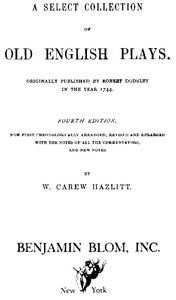
A Select Collection of Old English Plays, Volume 13 — Text and Context
Edition facts
The source record for A Select Collection of Old English Plays, Volume 13 — Text and Context measures this digital text at 125,600 words, 9 hr 7 min estimated reading time, and 55 detected text sections.
The text analysis averages about 14.6 words per sentence, while the detected sections provide another way to judge how the source is divided.
Project Gutenberg metadata also associates the work with “English drama,” connecting these edition facts with the source record’s subject description.
Calculated from edition completeness, EPUB availability, text structure and catalogue metadata. Not a user rating.
How this score is calculated
- Description quality20 pts
- Title & short description10 pts
- Source metadata20 pts
- Text length15 pts
- Chapters / structure15 pts
- EPUB file integrity20 pts
Total of 100 points, scaled to a 2.5-5.0 range. Editions with an empty description or a missing EPUB file are not scored.
Read the Text
Here had been his work, and here his wages.[28]
+Lieut.+ Come, come, we must make friends. [_Exeunt._
_Enter +Bloodhound+, +Tim+, and +Sim+._
+Blood.+ There, sirrah, there's his bond: run into the Strand, 'tis six weeks since the tallow-chandler fetched my hundred marks I lent him to set him up, and to buy grease; this is his day, I'll have his bones for't else, so pray tell him.
+Tim.+ But are a chandler's bones worth so much, father?
+Blood.+ Out, coxcomb!
+Sim.+ Worth so much! I know my master will make dice of them; then 'tis but letting Master Alexander carry them next Christmas to the Temple,[29] he'll make a hundred marks a night of them.
+Tim.+ Mass, that's true.
+Blood.+ And run to Master Ear-lack's the informer, in Thieving Lane, and ask him what he has done in my business. He gets abundance; and if he carry my cause with one false oath, he shall have Moll; he will take her with a little. Are you gone, sir?
+Blood.+ As you come by Temple Bar, make a step to th' Devil.
+Tim.+ To the Devil, father?
+Sim.+ My master means the sign of the Devil;[30] and he cannot hurt you, fool; there's a saint holds him by the nose.
+Tim.+ Sniggers! what does the devil and a saint both in a sign?
+Sim.+ What a question's that? what does my master and his prayer-book o' Sunday both in a pew?
+Blood.+[31] Well, well, ye gipsy, what do we both in a pew?
+Sim.+ Why, make a fair show; and the devil and the saint does no more.
+Blood.+ You're witty, you're witty. Call to the man o' th' house, bid him send in the bottles of wine to-night; they will be at hand i' th' morning. Will you run, sir?
+Tim.+ To the devil, as fast as I can, sir; the world shall know whose son I am. [_Exit._
+Blood.+ Let me see now for a poesy for the ring: never an end of an old saw? 'Tis a quick widow, Sim, and would have a witty poesy.
+Sim.+ If she be quick, she's with child; whosoever got it, you must father it; so that
_You come o' th' nick, For the widow's quick._
There's a witty poesy for your quick widow.
+Blood.+ No, no; I'll have one shall savour of a saw.
+Sim.+ Why then, 'twill smell of the painted cloth.[32]
+Blood.+ Let me see, _a widow witty_----
+Sim.+ _Is pastime pretty_:--put in that for the sport's sake.
+Blood.+ No, no, I can make the sport. Then, _an old man_----
+Sim.+ Then will she answer, _If you cannot, a younger can._[33] And look, look, sir, now I talk of the younger, yonder's Ancient Young come over again, that mortgaged sixty pound _per annum_ before he went; I'm deceived if he come not a day after the fair.
+Blood.+ Mine almanac!
+Sim.+ A prayer-book, sir?
+Blood.+ A prayer-book; for devout beggars I hate; look, I beseech thee. Fortune, now befriend me, and I will call the plaguy whore in. Let me see, six months.
_Enter +Ancient Young+._
+Anc.+ Yes, 'tis he, certain: this is a business must not be slackened, sir.
+Sim.+ Look, I beseech thee; we shall have oatmeal in our pottage six weeks after.
+Blood.+ Four days too late, Sim; four days too late, Sim.
+Sim.+ Plumbs in our pudding a Sunday, plumbs in our pudding.
+Anc.+ Master Bloodhound, as I take it.
+Blood.+ You're a stranger, sir. [_Aside._] You shall be witness, I shall be railed at else, they will call me devil. I pray you, how many months from the first of May to the sixth of November following?
+Anc.+ Six months and four days, just.
+Blood.+ I ask, because the first of May last, a noble gentleman, one Ancient Young----
+Anc.+ I am the man, sir.
+Blood.+ My spectacles, Sim: look, Sim, is this Ancient Young?
+Sim.+ 'Twas Ancient Young, sir.
+Blood.+ And is't not Ancient Young?
+Sim.+ No, sir, you have made him a young ancient.
+Blood.+ O Sim, a chair. I know him now, but I shall not live to tell him.
+Anc.+ How fare you, sir?
+Sim.+ The better for you; he thanks you, sir.
+Blood.+ Sick, sick, exceeding sick.
+Anc.+ O' th' sudden? Strange!
+Sim.+ A qualm of threescore years come over his stomach, nothing else.[34] [_Aside._
+Blood.+ That you, beloved you, who, of all men i' th' world, my poor heart doated on, whom I loved better than father, mother, brother, sister, uncles, aunts--what would you have? that you should stay four days too late!
+Anc.+ I have your money ready; And, sir, I hope your old love to my father----
The volume opens with Rowley's A Match at Mid-night, a city comedy whose dramatis personae immediately signal its satirical targets: a usurer named Bloodhound, a captain called Carvegut, and a constable named Busy. The play's first lines—a servant's greeting of 'Good morrow, Master Tim'—establish a brisk, colloquial rhythm that persists across the five works collected here. Hazlitt's editorial apparatus, including footnotes on contemporary slang and theatrical customs, frames each play as both a literary artifact and a document of performance practice.
Voice and Vernacular in the Dramatis Personae
The character lists themselves reveal the plays' linguistic texture. In A Match at Mid-night, names like 'Sir Marmaduke Many-Minds' and 'Ancient Young' encode moral or social commentary, while 'Sue Shortheels, a whore' and 'Mistress Coote, a bawd' announce their functions bluntly. The Welshman Randall and the clown Sim introduce dialect and malapropisms. Hazlitt's notes gloss terms such as 'niggars-noggers' and 'four-shillings' (ale), anchoring the dialogue in its period. The editor also traces allusions—for instance, linking 'Mare Liberum' to Grotius's treatise—demonstrating how the plays engage with contemporary intellectual debates.
Prologues, Epilogues, and Theatrical Framing
Several plays include multiple prologues and epilogues tailored to different venues: The City-Match has separate prologues 'To the King and Queen' and 'At Blackfriars,' while The Queen of Arragon features distinct epilogues for court and the Friars. These paratexts reveal how playwrights adjusted tone and address for elite versus public audiences. Hazlitt's footnotes occasionally cite contemporary performance records, such as the 'three soundings' of the trumpet before a play began. The inclusion of these framing devices allows readers to trace the shifting expectations of early modern theatregoers.
Hazlitt's Editorial Annotations as a Second Voice
William Carew Hazlitt's notes form a running commentary that both clarifies and complicates the plays. He cross-references other early modern works—citing Steevens on 'The Tempest,' Middleton's Chaste Maid in Cheapside, and the 'Vida de Lazarillo de Tormes'—to illuminate stage business and slang. His annotations on the 'echineis' fish and Sir Francis Drake show a scholarly impulse to connect dramatic metaphors to natural history and exploration. Yet the notes also preserve earlier editors' conjectures, creating a layered textual history. Readers encounter not just the plays but a Victorian editor's effort to reconstruct their original meanings.
Because the excerpts provide only the opening of A Match at Mid-night and scattered later passages, the full trajectory of each plot remains unclear. The edition rewards attention to its marginalia: Hazlitt's footnotes often contain the most vivid details about stagecraft and social context. Readers interested in the evolution of English comedy will find this volume a rich, if fragmentary, record of how plays were performed, printed, and preserved across three centuries.
The rain made the old Jacobean stage directions feel like eavesdropping on ghosts. Rowley’s mischief and Davenport’s midnight city lingered, but my mind kept drifting to a quieter devotion. Later, drying off, I found myself holding Polyeucte — Reading Notes, and the contrast—noisy passion versus holy stillness—felt like a gentle answer to something the plays had asked.
There are no reviews for this eBook.
What did you think of this book?
Answer a few questions and save a private reflection on this device.