About 129 minutes
The Lady from the Sea — A Closer Reading
Fantasy Juvenile Worlds
29,616 recorded words. 0 minutes difference from this book's estimate.
View Gutenberg source #2765
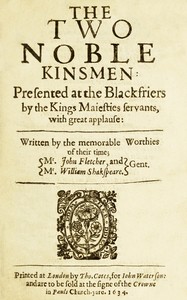
This digital edition of The Two Noble Kinsmen — Edition Insights is described by source-level measurements including 29,621 words, 2 hr 9 min estimated reading time, and 9 detected text sections.
The text analysis averages about 14.6 words per sentence, while the detected sections provide another way to judge how the source is divided.
Project Gutenberg metadata also associates the work with “Knights and knighthood -- Drama,” connecting these edition facts with the source record’s subject description.
Explore this collection
These alternatives are selected using recorded categories and estimated reading time.
About 129 minutes
Fantasy Juvenile Worlds
29,616 recorded words. 0 minutes difference from this book's estimate.
View Gutenberg source #2765About 130 minutes
Fantasy Juvenile Worlds
29,792 recorded words. 1 minutes difference from this book's estimate.
View Gutenberg source #7765About 125 minutes
Fantasy Juvenile Worlds
28,532 recorded words. 4 minutes difference from this book's estimate.
View Gutenberg source #47792Search stored excerpts and compare books → Choose by your preferences →
Choices use stored catalog measurements. Estimates vary with reading speed. A shared category is a catalog label, not a claim that two books have the same argument or literary quality.
Search reads excerpt text stored with this catalog and links to its associated Gutenberg record. The connection is stored in the site database; this tool does not recheck that every excerpt is word-for-word identical to that external record. Excerpt search does not cover every chapter and does not verify historical publication dates.
Catalog snapshot checked: 2026-09-26. Coverage: 90 public books, 90 available source excerpts.
Calculated from edition completeness, EPUB availability, text structure and catalogue metadata. Not a user rating.
Total of 100 points, scaled to a 2.5-5.0 range. Editions with an empty description or a missing EPUB file are not scored.
Public-domain source text
The source text is kept in the dedicated reader, separate from this catalogue record and its commentary.
The Two Noble Kinsmen opens with a Prologue that compares a new play to a maidenhead, a metaphor that immediately signals the work's self-awareness about its own reception. The speaker worries that the play, like a bride, might lose its honor if poorly received, and invokes Chaucer as the story's source. This framing device establishes a tone of anxious ambition, as the authors—Shakespeare and Fletcher—present themselves as inheritors of a noble literary tradition. The play's language oscillates between formal verse and colloquial exchanges, as seen in the arming scene where Palamon and Arcite discuss armor and past battles with a mixture of chivalric courtesy and intimate familiarity.
The Prologue uses a sustained analogy between a new play and a virgin bride, emphasizing the financial and reputational stakes of theatrical performance. The speaker claims the play has a “noble breeder and a pure, / A learned, and a poet never went / More famous yet ’twixt Po and silver Trent.” This geographical reference to the Po River in Italy and the Trent in England situates the play within a European literary landscape, while the mention of Chaucer as the source grounds it in English tradition. The Prologue's anxiety about failure—imagining a hiss from the audience that would make Chaucer “cry from underground”—reveals a concern for legacy that recurs throughout the play.
The arming scene between Palamon and Arcite demonstrates how dialogue conveys both rivalry and affection. Their exchange is filled with practical instructions—“thrust the buckle through far enough”—and reminiscences of past battles. Arcite recalls Palamon's charge on the left wing, noting “I never saw such valour,” while Palamon deflects praise. The physical act of arming each other becomes a ritual of trust, even as they prepare to fight to the death. The repeated use of “cousin” and “sweet cousin” maintains a tone of intimacy that contrasts with the violence they are about to commit. This duality is central to the play's exploration of bonds tested by love and honor.
The play's stage directions and descriptive passages are notably sparse, relying on dialogue to establish setting and action. For example, the arming scene contains no external description of the armor; instead, the audience learns through conversation that Arcite's armor is stolen from the Duke, and that Palamon prefers to fight bare-armed for nimbleness. The forest setting in Act III is similarly evoked through characters' movements and offstage sounds, such as the hunting horns that interrupt the duel. This economy of description places the burden on the actors and the audience's imagination, a technique that aligns with the collaborative authors' focus on character interaction over spectacle.
The Two Noble Kinsmen is categorized as a tragicomedy, and the excerpts reflect a deliberate blending of tones. The Prologue's metaphor of the play as a maidenhead suggests a concern with purity and genre expectations, while the arming scene's blend of courtly language and practical detail undercuts heroic conventions. The characters' awareness of their own folly—Arcite's exclamation “our folly has undone us” when the Duke approaches—adds a layer of irony. This self-consciousness extends to the play's structure, which alternates between high-stakes combat and moments of domestic intimacy, as seen in the jailer's daughter subplot (not fully excerpted here). The authors seem to question whether noble actions can survive the messiness of human emotion.
Readers approaching The Two Noble Kinsmen should attend to the interplay between the two authors' voices, particularly in scenes where formal verse gives way to naturalistic dialogue. The play rewards attention to small gestures—a buckle tightened, a memory shared—that reveal character more than grand speeches. Because the excerpts are incomplete, the full arc of the jailer's daughter subplot and the resolution of the duel remain outside this analysis, but the patterns of diction and dialogue visible here offer a starting point for understanding the play's unique texture.
This note on shared authorship brought me back to a rainy afternoon, puzzling over which lines in Two Noble Kinsmen felt like Fletcher’s breath and which like Shakespeare’s. I remembered the same gentle detective work with old plays in A Select Collection of Old English Plays, Volume 09 — Reading Companion—that sense of hearing two voices through one page, almost like eavesdropping on friends finishing each other’s sentences.
Use these questions to collect your thoughts before moving on.