About 129 minutes
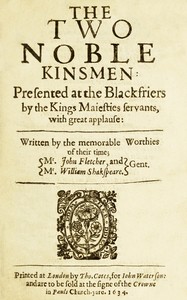
The Two Noble Kinsmen — Edition Insights
Fantasy Juvenile Worlds
29,621 recorded words. 0 minutes difference from this book's estimate.
View Gutenberg source #1506
For The Lady from the Sea — A Closer Reading, the stored edition analysis reports 29,616 words, 2 hr 9 min estimated reading time, and 4 detected text sections.
The text analysis averages about 9.9 words per sentence, while the detected sections provide another way to judge how the source is divided.
Project Gutenberg metadata also associates the work with “Man-woman relationships -- Drama,” connecting these edition facts with the source record’s subject description.
Explore this collection
These alternatives are selected using recorded categories and estimated reading time.
About 129 minutes
Fantasy Juvenile Worlds
29,621 recorded words. 0 minutes difference from this book's estimate.
View Gutenberg source #1506About 130 minutes
Fantasy Juvenile Worlds
29,792 recorded words. 1 minutes difference from this book's estimate.
View Gutenberg source #7765About 125 minutes
Fantasy Juvenile Worlds
28,532 recorded words. 4 minutes difference from this book's estimate.
View Gutenberg source #47792Search stored excerpts and compare books → Choose by your preferences →
Choices use stored catalog measurements. Estimates vary with reading speed. A shared category is a catalog label, not a claim that two books have the same argument or literary quality.
Search reads excerpt text stored with this catalog and links to its associated Gutenberg record. The connection is stored in the site database; this tool does not recheck that every excerpt is word-for-word identical to that external record. Excerpt search does not cover every chapter and does not verify historical publication dates.
Catalog snapshot checked: 2026-09-26. Coverage: 90 public books, 90 available source excerpts.
Calculated from edition completeness, EPUB availability, text structure and catalogue metadata. Not a user rating.
Total of 100 points, scaled to a 2.5-5.0 range. Editions with an empty description or a missing EPUB file are not scored.
Public-domain source text
The source text is kept in the dedicated reader, separate from this catalogue record and its commentary.
The opening stage direction of Ibsen's The Lady from the Sea establishes a visual contrast between the domestic garden—with its verandah, flagstaff, and arbour—and the wild expanse of fjord, mountains, and sea beyond. This spatial tension mirrors the central conflict of the play: Ellida Wangel's divided allegiance between her husband, Doctor Wangel, and the mysterious Stranger who embodies the ocean's freedom. Eleanor Marx Aveling's translation renders the dialogue with a naturalistic rhythm, shifting from casual exchanges about painting and fishing to charged, elliptical confrontations. The play's five-act structure builds toward a climactic choice, with the Stranger's repeated insistence on Ellida's free will—"Freely," he says—becoming a refrain that underscores the theme of autonomy.
The setting is not merely scenic but functional. The garden hedge and gate separate the domestic sphere from the road and seashore, a boundary that characters cross repeatedly. Ballested, the painter, works on a canvas of "the fjord there between the islands," yet the figure is missing—a detail that hints at Ellida's own sense of incompleteness. The Stranger arrives from the sea and departs toward it, his movements timed to the steamer's schedule. Ellida's language reflects this pull: she speaks of the sea as a place where the Stranger "belongs," and her final confrontation with him occurs in the garden, the threshold between two worlds. The play's visual and verbal imagery consistently ties emotional states to the landscape, making the fjord a silent participant in the drama.
Aveling's translation preserves Ibsen's use of short, clipped exchanges to build suspense. In Act I, the conversation between Bolette and Ballested about the flag and Arnholm's visit is leisurely, but the pace quickens when Ellida enters. The Stranger's speeches are marked by deliberate pauses and repetitions—"Tomorrow night," "Freely," "Then all is at an end"—that create a rhythmic urgency. Ellida's responses shift from imploring to breathless, as when she cries "Oh! don't look at me like that!" The stage directions, such as "in low, trembling tone" or "passionately," guide the reader's sense of tempo. The final act's confrontation is a masterclass in accelerating tension, with the Stranger's calm ultimatum contrasting sharply with Ellida's panic and Wangel's attempts at control.
Ellida's dialogue reveals a woman caught between duty and desire. She describes her marriage to Wangel as a safe harbor, yet the Stranger's arrival awakens a longing she cannot articulate. Her repeated pleas—"Save me, Wangel!"—give way to moments of defiance: "He shall not be imprisoned. He belongs out there." The Stranger's insistence on her free choice—"you must go with him freely"—forces Ellida to confront her own will. Aveling's translation captures this ambiguity: Ellida's lines often trail off into dashes or ellipses, suggesting thoughts she cannot fully express. The play does not resolve her conflict neatly; instead, it leaves her poised between two futures, her final decision ambiguous in the excerpts provided.
Readers should attend to the play's use of visual symbols—the flag, the painting, the garden gate—as markers of psychological states. The translation by Eleanor Marx Aveling, a prominent socialist and translator, brings a clarity to Ibsen's prose that rewards careful reading of stage directions and dialogue rhythms. The incomplete excerpts leave Ellida's ultimate choice unknown, but the play's power lies in the tension leading up to it.
Sometimes I think of Ellida standing at the water’s edge, torn between a known shore and the stranger’s restless tide—how the old translations catch that ache, and then, strangely, it reminds me of the unadorned weight in Shorter Bible Plays — Edition Insights. Both feel like listening to someone breathe through a hard choice, and I’m just glad such quiet versions exist.
Capture what you thought, learned, and would like to remember.