About 36 minutes
Three plays — Themes and Context
Historical Psychological Social Fiction
8,129 recorded words. 14 minutes difference from this book's estimate.
View Gutenberg source #17187
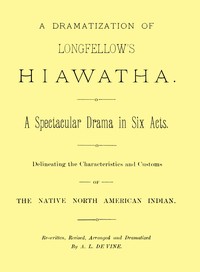
For A dramatization of Longfellow's Hiawatha: A spectacular drama in six acts — Context and Discussion, the stored edition analysis reports 11,484 words, 50 min estimated reading time, and 10 detected text sections.
The text analysis averages about 21.4 words per sentence, while the detected sections provide another way to judge how the source is divided.
Project Gutenberg metadata also associates the work with “Indians of North America -- Drama,” connecting these edition facts with the source record’s subject description.
Explore this collection
These alternatives are selected using recorded categories and estimated reading time.
About 36 minutes
Historical Psychological Social Fiction
8,129 recorded words. 14 minutes difference from this book's estimate.
View Gutenberg source #17187About 36 minutes
Historical Psychological Social Fiction
8,166 recorded words. 14 minutes difference from this book's estimate.
View Gutenberg source #62494About 79 minutes
Historical Psychological Social Fiction
18,161 recorded words. 29 minutes difference from this book's estimate.
View Gutenberg source #16379Search stored excerpts and compare books → Choose by your preferences →
Choices use stored catalog measurements. Estimates vary with reading speed. A shared category is a catalog label, not a claim that two books have the same argument or literary quality.
Search reads excerpt text stored with this catalog and links to its associated Gutenberg record. The connection is stored in the site database; this tool does not recheck that every excerpt is word-for-word identical to that external record. Excerpt search does not cover every chapter and does not verify historical publication dates.
Catalog snapshot checked: 2026-09-26. Coverage: 90 public books, 90 available source excerpts.
Calculated from edition completeness, EPUB availability, text structure and catalogue metadata. Not a user rating.
Total of 100 points, scaled to a 2.5-5.0 range. Editions with an empty description or a missing EPUB file are not scored.
Public-domain source text
The source text is kept in the dedicated reader, separate from this catalogue record and its commentary.
Alice L. De Vine's 1895 dramatization of Longfellow's Hiawatha transforms the narrative poem into a six-act stage spectacle, complete with detailed stage directions, song lyrics, and allegorical figures. The adaptation retains Longfellow's distinctive trochaic tetrameter, as seen in Hiawatha's lament: "O this long and dreary Winter / O this cold and cruel Winter!" De Vine's introductory note frames the work as an educational portrayal of Native American life, claiming it "will be found historical, an educator to the young and interesting to all." The drama incorporates dances, tableaux, and colored lights, with explicit instructions for a "national Indian dance" and soft music behind scenes.
De Vine adheres closely to Longfellow's trochaic meter, a rhythmic choice that gives the dialogue a chant-like quality. In Act V, Hiawatha's speech follows the same pattern: "Ever thicker, thicker, thicker / Grows the ice on lake and river." The repetition of words like "thicker" and "deeper" mimics the poem's incantatory style. However, the dramatization occasionally shifts into prose for stage directions, creating a contrast between the poetic dialogue and the practical instructions for staging. The lullaby in Act II, with its refrain "O my sweetheart, my Algonquin!" preserves the lyrical repetition of the original, while the ghostly figures of Fever and Famine speak in a more fragmented, sorrowful rhythm: "Sobbing, weeping, wailing." This variation in voice—from epic declamation to intimate song—shows De Vine's attempt to balance fidelity to the poem with theatrical necessity.
The play's stage directions are unusually elaborate, often carrying the narrative weight. In Act V, the entrance of Fever and Famine is described in detail: "Two women entered softly, / Passed the doorway uninvited, / Without word of salutation." The directions specify their appearance—"two tall, slim girls, with white, haggard faces, dressed entirely in black drapery"—and their movements: "Crouching low among the shadows." These instructions not only guide the actors but also create a visual allegory that reinforces the themes of suffering and supernatural intervention. Similarly, the synopsis for Act III includes a note: "Indian pastimes, games, dances and specialties should be here introduced," leaving room for improvisation. The stage directions thus function as a hybrid of script and production manual, reflecting the play's origins as a "spectacular drama" intended for live performance.
The six-act structure shifts between intimate scenes and large-scale spectacle. Act I opens with Gitche Manitou descending from heaven, fashioning a peace pipe, and setting fire to the forest—a grand visual effect. In contrast, Act V focuses on the claustrophobic interior of Nokomis's tepee, where Hiawatha, Nokomis, and Minnehaha show "starvation and great suffering." The allegorical figures of Fever and Famine slow the pace, their mournful dialogue and static presence creating a tableau of despair. The play then accelerates into dance sequences: "The Harvest Dance, Ghost Dance or a War Dance, with colored lights thrown upon the scene." This alternation between static, dialogue-heavy scenes and dynamic, music-driven spectacle shapes the rhythm of the drama, moving from epic exposition to personal tragedy to celebratory performance.
Readers approaching this dramatization should attend to the interplay between Longfellow's poetic language and De Vine's theatrical innovations. The stage directions offer a window into late-nineteenth-century performance practices, while the allegorical figures and dance sequences reveal the era's fascination with spectacle and moral instruction. The play's claim to be "the first and only known drama of this kind" invites comparison with other adaptations of epic poetry for the stage.
The rain tapped the window while I worked through De Vine’s Hiawatha, noticing how her stage directions gave even Fever and Famine a kind of mournful dignity. That patience for suffering lingered. Later, half-absorbed, I picked up The Return of Peter Grimm — Themes and Context and found the same quiet reverence for what cannot be hurried — losses that ask only to be witnessed, not fixed.
Build a private reading journal entry for this title.