About 36 minutes
Three plays — Themes and Context
Historical Psychological Social Fiction
8,129 recorded words. 0 minutes difference from this book's estimate.
View Gutenberg source #17187
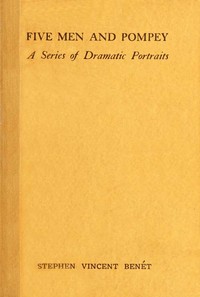
Before opening Five Men and Pompey: A Series of Dramatic Portraits — Text and Context, the edition data offers a quick orientation: 8,166 words, 36 min estimated reading time, and 9 detected text sections.
The text analysis averages about 16.6 words per sentence, while the detected sections provide another way to judge how the source is divided.
Project Gutenberg metadata also associates the work with “Pompey, the Great, 106 B.C.-48 B.C. -- Drama,” connecting these edition facts with the source record’s subject description.
Explore this collection
These alternatives are selected using recorded categories and estimated reading time.
About 36 minutes
Historical Psychological Social Fiction
8,129 recorded words. 0 minutes difference from this book's estimate.
View Gutenberg source #17187About 50 minutes
Historical Psychological Social Fiction
11,484 recorded words. 14 minutes difference from this book's estimate.
View Gutenberg source #67148About 79 minutes
Historical Psychological Social Fiction
18,161 recorded words. 43 minutes difference from this book's estimate.
View Gutenberg source #16379Search stored excerpts and compare books → Choose by your preferences →
Choices use stored catalog measurements. Estimates vary with reading speed. A shared category is a catalog label, not a claim that two books have the same argument or literary quality.
Search reads excerpt text stored with this catalog and links to its associated Gutenberg record. The connection is stored in the site database; this tool does not recheck that every excerpt is word-for-word identical to that external record. Excerpt search does not cover every chapter and does not verify historical publication dates.
Catalog snapshot checked: 2026-09-26. Coverage: 90 public books, 90 available source excerpts.
Calculated from edition completeness, EPUB availability, text structure and catalogue metadata. Not a user rating.
Total of 100 points, scaled to a 2.5-5.0 range. Editions with an empty description or a missing EPUB file are not scored.
Public-domain source text
The source text is kept in the dedicated reader, separate from this catalogue record and its commentary.
Benét's Five Men and Pompey opens with Sertorius, a rebel leader in Spain, speaking in a breathless, fragmented monologue that mixes military calculation with private grief. The verse moves from clipped tactical lines—'The net is cast: / Cast, and draws ever tighter'—to a sudden, aching recollection of a lost woman: 'Ah, Nydia! Nydia! Had you not died.' This shift in register, from the language of siege to the language of loss, sets the pattern for the entire work. Each of the five dramatic portraits uses a distinct rhythm and emotional temperature, so that the reader experiences the same historical events from inside radically different minds.
The first portrait, 'The Last Banquet,' gives Sertorius a voice that is both weary and volatile. Benét marks the speaker's exhaustion through short, broken lines: 'Twelve years! Twelve years of striving! and at last / My power is—secure?' The dash and the question together signal a man who cannot believe his own success. As the monologue progresses, the syntax becomes more fractured, mirroring the conspiracy closing in. When Sertorius suddenly cries 'Guards! Guards!—I think you will not rise again, / Perpenna, from that blow!' the pace accelerates into action, but the scene is already over. Benét uses these abrupt tempo changes to keep the reader off balance, as if the historical outcome—Sertorius's assassination—is both inevitable and shocking.
In 'De Bello Civili,' Benét constructs Caesar's monologue as a reading of letters, a device that allows the voice to shift between public argument and private memory. The opening lines mimic the clipped, rational tone of a statesman weighing options: 'H'm. “Rome mistaken—.” H'm.' But as Caesar recalls a friend from his youth, the verse opens into long, sensuous lines: 'Under the blazing stars. A brown slave girl / Plucked at a lute whose drowsy murmur died / Throbbingly into sweetness.' This lyrical passage, with its piled colors—'Crimson like pigeon’s blood, blue like the sea, / Yellow like old, old ivory'—contrasts sharply with the political calculations that frame it. The poem then pivots again, presenting a verse letter from Calinus that condemns Caesar in a different, prophetic voice. The result is a portrait of a man torn between nostalgia and ambition, his decision to march on Ariminum presented as a sudden, almost arbitrary break.
The final portrait, 'After Pharsalia,' gives Pompey a sparse, elegiac tone. The opening line—'So it is over; you have won at last'—is direct and flat, stripped of the rhetorical flourishes that mark Caesar's speech. Pompey's voice is that of a man who has already lost, and Benét keeps the lines short and declarative: 'Freedom and the Republic. Once. No more.' The repetition of 'Freedom' and the single-word sentence 'Once' create a rhythm of finality. Unlike Sertorius, who rages against his fate, or Caesar, who hesitates and then acts, Pompey simply observes his own defeat. The pace is slow, almost static, as if the speaker is already becoming a historical figure rather than a living man. This deliberate deceleration gives the sequence a somber close, emphasizing that the Republic's end is not a dramatic collapse but a quiet extinguishing.
Because the excerpts provide only five of the nine text sections, the reader encounters the work as a series of intense, self-contained moments rather than a continuous narrative. Benét's method rewards attention to small shifts in line length, punctuation, and diction—each speaker's voice is a distinct instrument. Reading the portraits in order reveals a deliberate arc: from the frantic energy of Sertorius, through the layered indecision of Caesar, to the resigned stillness of Pompey. The gaps between the monologues are as telling as the speeches themselves.
Reading Five Men and Pompey, I kept thinking how loyalty, once fractured, leaves a peculiar silence in its wake. There’s a similar ache in the older voices of Four Plays of Aeschylus — A Closer Reading, where memory weighs heavier than any crown. Sometimes the past isn’t a lesson; it’s just company that stays. I remember that feeling long after the page turns.
Answer a few questions and save a private reflection on this device.