About 558 minutes
Robert Greene: [Six Plays] — Background and Themes
Historical Psychological Social Fiction
128,214 recorded words. 19 minutes difference from this book's estimate.
View Gutenberg source #55769
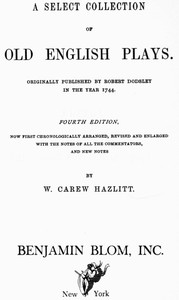
This digital edition of A Select Collection of Old English Plays, Volume 15 — Themes and Context is described by source-level measurements including 123,809 words, 8 hr 59 min estimated reading time, and 55 detected text sections.
The text analysis averages about 10.7 words per sentence, while the detected sections provide another way to judge how the source is divided.
Project Gutenberg metadata also associates the work with “English drama,” connecting these edition facts with the source record’s subject description.
Explore this collection
These alternatives are selected using recorded categories and estimated reading time.
About 558 minutes
Historical Psychological Social Fiction
128,214 recorded words. 19 minutes difference from this book's estimate.
View Gutenberg source #55769About 341 minutes
Historical Psychological Social Fiction
78,402 recorded words. 198 minutes difference from this book's estimate.
View Gutenberg source #71187About 312 minutes
Historical Psychological Social Fiction
71,722 recorded words. 227 minutes difference from this book's estimate.
View Gutenberg source #35109Search stored excerpts and compare books → Choose by your preferences →
Choices use stored catalog measurements. Estimates vary with reading speed. A shared category is a catalog label, not a claim that two books have the same argument or literary quality.
Search reads excerpt text stored with this catalog and links to its associated Gutenberg record. The connection is stored in the site database; this tool does not recheck that every excerpt is word-for-word identical to that external record. Excerpt search does not cover every chapter and does not verify historical publication dates.
Catalog snapshot checked: 2026-09-26. Coverage: 90 public books, 90 available source excerpts.
Calculated from edition completeness, EPUB availability, text structure and catalogue metadata. Not a user rating.
Total of 100 points, scaled to a 2.5-5.0 range. Editions with an empty description or a missing EPUB file are not scored.
Public-domain source text
The source text is kept in the dedicated reader, separate from this catalogue record and its commentary.
The four plays in this volume share a structural reliance on rapid scene changes and characters moving between houses, gardens, and chambers. In the excerpt from Elvira, a back-stairs and garden door provide an escape route, while Don Henrique's house becomes a stage for confrontations about honor. The dialogue often pivots on misunderstandings of location—Don Carlos insists he found Porcia in Octavio's house, even as Don Henrique claims she was at home. This spatial confusion drives the plot, with characters repeatedly entering and exiting to raise or allay suspicion.
The plays exploit physical movement between rooms and buildings to generate dramatic tension. In Elvira, Flora directs Don Octavio to a back-stairs leading to the garden, and the stage direction Scene changes to Don Henrique's house signals a swift transition. Don Henrique's line, “She's in her chamber now, unless by new Enchantments carried thence,” underscores how easily characters can be displaced. The same technique appears in The Adventures of Five Hours, where the first scene is set in Seville, a city that itself becomes a labyrinth of encounters. These shifts are not merely decorative; they create the possibility that characters may be in two places at once, as when Don Henrique laughs at the impossibility of Porcia being both at home and in Octavio's house. The structure thus mirrors the plays' central anxieties about fidelity and knowledge.
Light and darkness recur as motifs tied to revelation and concealment. In Elvira, Flora blows out a candle, and Diego comments, “'Tis a strong breath that can o'ercome a snuff.” The snuffed candle leaves the stage dark, a condition Diego prefers because he “hate[s] to be kill'd in [his] own presence.” This small action encapsulates a larger pattern: characters seek darkness to hide deeds or identities, while light threatens exposure. Don Henrique's “philosophical preamble” about happiness being a stranger to mankind uses the metaphor of motion—forced versus natural—to describe fortune's decline. The interplay of visibility and obscurity extends to the plays' titles: The Worst Not Always True suggests that appearances deceive, and the characters' repeated misidentifications depend on who sees whom, and in what light.
Dialogue in these plays often takes the form of argumentative set-pieces where characters debate honor, truth, and perception. Don Carlos and Don Henrique's exchange in Elvira is a case in point: Don Carlos insists he found Porcia “in Octavio's house,” while Don Henrique counters with logical impossibility. The language is formal, with balanced clauses and rhetorical questions—“Is the dishonour of our family becoming a laughing matter?”—that heighten the stakes. The preface to The Marriage Night notes that the play was “made out of the Spanish,” and the influence of Spanish honor drama is evident in the characters' preoccupation with reputation. Even when the tone turns comic, as in Diego's aside about the candle, the underlying concern remains: how to preserve one's name when actions are misconstrued.
W. Carew Hazlitt's introduction to Elvira provides a biographical sketch of George Digby, Earl of Bristol, quoting Horace Walpole's description of him as “a singular person, whose life was one contradiction.” Hazlitt notes that Digby wrote two plays from Spanish sources between 1662 and 1665, and that Elvira may be one of them with a new title. This editorial apparatus invites readers to consider how the plays' themes of mistaken identity and double dealing reflect the author's own political and personal inconsistencies. The volume also includes a preface to the third edition of The Adventures of Five Hours, indicating that these works were revised and reprinted, suggesting their popularity. Hazlitt's notes and glossarial index further situate the plays within the broader context of Restoration drama.
Readers approaching this volume should attend to the stage directions and scene headings, which often carry as much weight as the dialogue. The plays reward attention to who enters when, and from where, as these movements frequently signal shifts in power or knowledge. The editorial notes by Hazlitt offer clues about textual history, but the primary pleasure lies in watching characters navigate the narrow spaces between truth and appearance.
I keep returning to the closed doors of those Restoration rooms, the hurried whispers and fumbled locks. It reminded me of something older, starker—the threshold in Aeschylus where a name carried fate. There, no clever repartee would save anyone. Just the weight of a word spoken too late. Four Plays of Aeschylus — A Closer Reading sits beside it on my shelf now, quietly.
Save your reaction, strongest insight, and memorable passage.