About 83 minutes
Little Dramas for Primary Grades — Story, Setting & Ideas
Historical Psychological Social Fiction
19,054 recorded words. 6 minutes difference from this book's estimate.
View Gutenberg source #53245
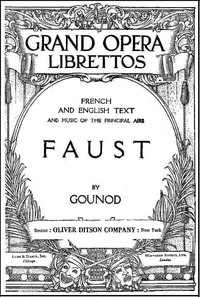
This digital edition of Faust: A Lyric Drama in Five Acts — A Closer Reading is described by source-level measurements including 20,446 words, 1 hr 29 min estimated reading time, and 6 detected text sections.
The text analysis averages about 10.4 words per sentence, while the detected sections provide another way to judge how the source is divided.
Project Gutenberg metadata also associates the work with “Operas -- Librettos,” connecting these edition facts with the source record’s subject description.
Explore this collection
These alternatives are selected using recorded categories and estimated reading time.
About 83 minutes
Historical Psychological Social Fiction
19,054 recorded words. 6 minutes difference from this book's estimate.
View Gutenberg source #53245About 79 minutes
Historical Psychological Social Fiction
18,161 recorded words. 10 minutes difference from this book's estimate.
View Gutenberg source #16379About 103 minutes
Historical Psychological Social Fiction
23,648 recorded words. 14 minutes difference from this book's estimate.
View Gutenberg source #790Search stored excerpts and compare books → Choose by your preferences →
Choices use stored catalog measurements. Estimates vary with reading speed. A shared category is a catalog label, not a claim that two books have the same argument or literary quality.
Search reads excerpt text stored with this catalog and links to its associated Gutenberg record. The connection is stored in the site database; this tool does not recheck that every excerpt is word-for-word identical to that external record. Excerpt search does not cover every chapter and does not verify historical publication dates.
Catalog snapshot checked: 2026-09-26. Coverage: 90 public books, 90 available source excerpts.
Calculated from edition completeness, EPUB availability, text structure and catalogue metadata. Not a user rating.
Total of 100 points, scaled to a 2.5-5.0 range. Editions with an empty description or a missing EPUB file are not scored.
Public-domain source text
The source text is kept in the dedicated reader, separate from this catalogue record and its commentary.
This libretto for Charles Gounod's opera Faust presents a dual-language edition (English and French) that captures the rhythmic and rhyming structure of the original verse. The text opens with a prefatory note and a detailed table of contents, then moves directly into the drama. The first act establishes a stark contrast between Faust's scholarly despair and the Easter chorus's promise of resurrection, a pattern of juxtaposition that recurs throughout. The libretto's stage directions and character interactions reveal a world where sacred and profane constantly collide, from Valentin's prayer over his sister's medal to Mephistopheles' cynical 'Calf of Gold' song. The inclusion of selected arias and a soldier's chorus further emphasizes the work's musical and dramatic architecture.
The libretto repeatedly places sacred objects in secular contexts, creating a tension between faith and worldly ambition. In Act II, Valentin enters holding a small medal given by his sister Marguerite, praying: 'O sainte médaille, Qui me viens de ma sœur, Au jour de la bataille, Pour écarter la mort, reste là sur mon cœur!' This invocation of divine protection for military glory is immediately followed by a drinking song from Wagner about a cowardly rat, and then Mephistopheles' entrance with his irreverent 'Le veau d'or' (The Calf of Gold) chorus. The juxtaposition suggests that sacred tokens are invoked but quickly overshadowed by hedonistic pursuits. Similarly, the soldier's chorus equates 'filles ou forteresses' (girls or fortresses) as objects to be conquered, reducing both love and war to games of capture. These recurring contrasts between piety and profanity form a structural pattern that defines the opera's moral landscape.
The libretto's extensive choral passages delineate distinct social groups—soldiers, students, young girls, matrons, and burghers—each with their own musical and textual motifs. The students sing of wine and revelry ('Vin ou bière, Bière ou vin, Que mon verre Soit plein!'), while the soldiers boast of conquering both fortresses and women. The young girls, observing the men, sing 'Voyez ces hardis compères Qui viennent là-bas; Ne soyons pas trop sévères, Retardons le pas,' indicating a coquettish awareness. The matrons, in turn, mock the girls and students: 'Voyez après ces donzelles Courir ces messieurs! Nous sommes aussi bien qu'elles, Sinon beaucoup mieux!' This layered commentary creates a social microcosm where each group's perspective is voiced, but no single viewpoint dominates. The choral structure thus mirrors the opera's thematic tensions between individual desire and communal norms.
Mephistopheles' first appearance is marked by an interruption: he cuts off Wagner's song about a rat, saying 'Pardon!' and then 'Permettez-moi de prendre place!' This intrusion disrupts the festive atmosphere and signals his role as a destabilizing force. Wagner, who had been standing on a stool to perform, descends and yields the floor. Mephistopheles then offers to sing 'plusieurs de ma façon,' immediately launching into the cynical 'Calf of Gold' chorus. The interruption is not merely a plot point but a structural pattern: throughout the libretto, Mephistopheles repeatedly inserts himself into scenes, breaking the flow of everyday life. This device underscores his function as a catalyst who exposes the underlying tensions between sacred and secular, order and chaos. The libretto's stage directions emphasize his sudden appearance ('paraissant tout à coup'), reinforcing his supernatural nature.
Readers approaching this libretto should attend to the interplay between the English and French texts, as the translation choices sometimes alter emphasis. The dual-column format of the original is here split into sequential sections, which may affect the experience of parallel reading. The selected arias at the end provide a musical summary, but the full dramatic effect depends on imagining the orchestration and staging implied by the text. The libretto rewards attention to its choral structures and recurring motifs of interruption and juxtaposition.
The rain tapped against the window while Marguerite’s prayer lingered in my mind, that fragile hope against Mephistopheles’ gold. Later, I found myself drifting toward the shelf, pulling down Children's Classics in Dramatic Form, Book Two — A Reader’s Guide almost without thinking. There, simpler dramas held their own quiet weight, and I recalled how even children’s stories carry the same old shadows.
Answer a few questions and save a private reflection on this device.