About 79 minutes
Children's Classics in Dramatic Form, Book Two — A Reader’s Guide
Historical Psychological Social Fiction
18,161 recorded words. 4 minutes difference from this book's estimate.
View Gutenberg source #16379
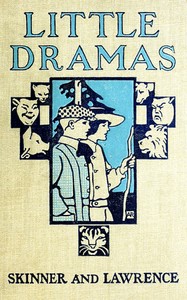
This digital edition of Little Dramas for Primary Grades — Story, Setting & Ideas is described by source-level measurements including 19,054 words, 1 hr 23 min estimated reading time, and 41 detected text sections.
The text analysis averages about 10.3 words per sentence, while the detected sections provide another way to judge how the source is divided.
Project Gutenberg metadata also associates the work with “Children's plays,” connecting these edition facts with the source record’s subject description.
Explore this collection
These alternatives are selected using recorded categories and estimated reading time.
About 79 minutes
Historical Psychological Social Fiction
18,161 recorded words. 4 minutes difference from this book's estimate.
View Gutenberg source #16379About 89 minutes
Historical Psychological Social Fiction
20,446 recorded words. 6 minutes difference from this book's estimate.
View Gutenberg source #45806About 103 minutes
Historical Psychological Social Fiction
23,648 recorded words. 20 minutes difference from this book's estimate.
View Gutenberg source #790Search stored excerpts and compare books → Choose by your preferences →
Choices use stored catalog measurements. Estimates vary with reading speed. A shared category is a catalog label, not a claim that two books have the same argument or literary quality.
Search reads excerpt text stored with this catalog and links to its associated Gutenberg record. The connection is stored in the site database; this tool does not recheck that every excerpt is word-for-word identical to that external record. Excerpt search does not cover every chapter and does not verify historical publication dates.
Catalog snapshot checked: 2026-09-26. Coverage: 90 public books, 90 available source excerpts.
Calculated from edition completeness, EPUB availability, text structure and catalogue metadata. Not a user rating.
Total of 100 points, scaled to a 2.5-5.0 range. Editions with an empty description or a missing EPUB file are not scored.
Public-domain source text
The source text is kept in the dedicated reader, separate from this catalogue record and its commentary.
The thirty-one short plays in Little Dramas for Primary Grades are built around a consistent structural pattern: a brief cast list, a simple setting, and dialogue that carries the entire action. The compilers, Ada Maria Skinner and Lillian Nixon Lawrence, draw on both original pieces and adaptations from authors such as Laura E. Richards and H. T. Peck. The dramas rely heavily on repetition and patterned exchanges—characters often ask a question and receive a series of similar answers before reaching a resolution. This design supports beginning readers by reinforcing vocabulary and sentence structures through oral performance.
Many of the plays use a cumulative question-and-answer format. In “Who Holds Up the Sky?” Daisy asks Rose, “Is it you holds up the sky?” Rose then asks the Fir Tree, who passes the question to the Elm, and so on. Each character denies responsibility and points to the next, until the Mountain is named. The same pattern appears in “The Little Fish,” where one fish after another is asked to help, and each refuses. This structure gives young readers predictable cues and allows them to anticipate the next line, building confidence in oral reading. The repetition also creates a rhythm that makes the dialogue easier to memorize for classroom performance.
Nature is frequently given a voice and a moral role. In “The Little Christmas Tree,” a Boastful Bamboo is humbled after a storm, admitting, “I wish that I had lived in a garden as you have.” The Little Tree, though damaged, survives because it was planted by children. In “Return of Spring,” Spring himself is a character who explains that farmers blamed him for making buds come out too soon. The gardeners were angry, he says, because “where I stepped, the flowers came out too soon.” These personifications teach cause and effect and humility without overt moralizing, embedding lessons in the natural consequences of the characters’ actions.
Characters are defined almost entirely by what they say and how they say it. In “Return of Spring,” the Clown’s absurd explanation of how to make rabbit pie—involving a hole in the crust and rabbits popping in—reveals his playful nature, while Columbine’s firm “Don’t you believe him” shows her as the sensible one. Pantaloon’s “Ho! ho! ho!” and his wand-waving establish him as a magician figure. In “The Odd Man and the Dog True,” the Dog’s loyalty is shown through his repeated offers to help, while the Odd Man’s selfishness is evident in his dismissive replies. No narrator explains motives; the dialogue carries all characterization, making the plays ideal for young actors to interpret through tone and delivery.
The plays require very few props or set pieces. Settings are described in a single line—“Time — Morning—Breakfast Place — A Garden on Mt. Olympus” for “Return of Spring”—and costumes are implied only by character names. The preface notes that the book is intended for use “at the end of the first, and at the beginning of the second, year,” suggesting that teachers could stage these with minimal preparation. Many plays, like “Bunny Rabbit” and “The Fox and the Crow,” have only two or three characters, allowing small groups to perform simultaneously. The simplicity of staging puts the focus squarely on the spoken word and the child’s ability to inhabit a role through voice alone.
The plays reward attention to how each character’s language differs—from the formal politeness of Rose to the Clown’s rambling nonsense. Readers might try comparing the rhythm of the cumulative plays with the more naturalistic dialogue in pieces like “Christmas Eve in an Attic.” The collection offers a practical glimpse into early twentieth-century educational methods, where drama was used not as a special event but as a regular part of reading instruction.
I remember holding that slim 1913 volume, its little dramas teaching children that even trees could speak with patience. Years later, I found a quieter echo in Five Men and Pompey: A Series of Dramatic Portraits — Text and Context. Both trust the voice alone to carry meaning, the simplest stage. It feels like watching one generation whisper to another. No scenery, just presence, and the strange dignity of someone simply speaking their truth aloud.
Build a private reading journal entry for this title.