About 45 minutes
Augustus Does His Bit: A True-to-Life Farce — A Closer Reading
Fantasy Juvenile Worlds
10,177 recorded words. 5 minutes difference from this book's estimate.
View Gutenberg source #3487
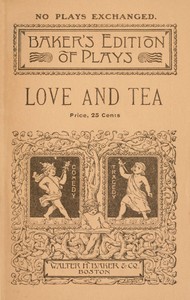
The catalog record for Love and tea: A comedy-drama of colonial times in two acts — Key Ideas to Explore provides practical reading context through 11,400 words, 50 min estimated reading time, and 9 detected text sections.
The text analysis averages about 10.2 words per sentence, while the detected sections provide another way to judge how the source is divided.
Project Gutenberg metadata also associates the work with “United States -- History -- Revolution, 1775-1783 -- Drama,” connecting these edition facts with the source record’s subject description.
Explore this collection
These alternatives are selected using recorded categories and estimated reading time.
About 45 minutes
Fantasy Juvenile Worlds
10,177 recorded words. 5 minutes difference from this book's estimate.
View Gutenberg source #3487About 56 minutes
Fantasy Juvenile Worlds
12,688 recorded words. 6 minutes difference from this book's estimate.
View Gutenberg source #27670About 43 minutes
Fantasy Juvenile Worlds
9,697 recorded words. 7 minutes difference from this book's estimate.
View Gutenberg source #33321Search stored excerpts and compare books → Choose by your preferences →
Choices use stored catalog measurements. Estimates vary with reading speed. A shared category is a catalog label, not a claim that two books have the same argument or literary quality.
Search reads excerpt text stored with this catalog and links to its associated Gutenberg record. The connection is stored in the site database; this tool does not recheck that every excerpt is word-for-word identical to that external record. Excerpt search does not cover every chapter and does not verify historical publication dates.
Catalog snapshot checked: 2026-09-26. Coverage: 90 public books, 90 available source excerpts.
Calculated from edition completeness, EPUB availability, text structure and catalogue metadata. Not a user rating.
Total of 100 points, scaled to a 2.5-5.0 range. Editions with an empty description or a missing EPUB file are not scored.
Public-domain source text
The source text is kept in the dedicated reader, separate from this catalogue record and its commentary.
The play opens in April 1775, days after Lexington, with Miss Lavinia Boltwood, a 'despotic spinster,' presiding over a living room where tea—and loyalty—are under scrutiny. The dialogue quickly establishes a web of suspicion: Mrs. Strong, the village gossip, reports that Judge Ingram, a mild Tory, has been arrested as a British spy. Miss Boltwood's fierce defense ('I will not hear Stephen Ingram traduced') contrasts with the neighbors' malicious relish. The scene hinges on reputation and rumor, not action; characters react to news rather than drive events. See uses the tea boycott as a backdrop for personal conflicts, weaving political tensions into domestic exchanges.
The excerpts show that the plot advances almost entirely through reported events and hearsay. The central crisis—Judge Ingram's arrest as a spy—reaches the stage secondhand, via Mrs. Strong and Mrs. Cowles. Miss Boltwood's indignation ('I care not what reports are rife; I know the man') sets up a contrast between public accusation and private conviction. The play's comedy-drama tension arises from this gap: characters must act on incomplete information, and their choices reveal character. Mrs. Strong's spiteful line 'Mayhap you would prefer solitude for the recovery of your equanimity' exemplifies how gossip serves both plot and characterization.
Miss Boltwood is described as 'despotic,' yet the excerpts show her as emotionally exposed. When she hears of the Judge's arrest, she nearly faints; Betty fetches wine, and Mrs. Cowles burns a turkey feather as a restorative—a comic detail that undercuts the gravity. Miss Boltwood's authority is asserted through commands ('Mandy! Run to Clapp’s Tavern') but also through her insistence on personal loyalty over public opinion. Her declaration 'Methinks I have some influence on both sides of this quarrel' suggests a woman navigating a divided community, but the excerpts leave unclear whether her influence is real or imagined.
The play's setting—a comfortable living room—becomes a microcosm of colonial conflict. Characters enter bearing news, roses, or wine; the stage directions emphasize domestic props (turkey wing, basket, guinea) that ground political drama in household routines. The arrival of Judge Ingram in minuteman uniform, supporting the wounded William, shifts the tone from gossip to action, but the scene remains interior. See uses the home as a space where women and men negotiate loyalty, but the excerpts offer only a glimpse of this shift. The play's two-act structure, spanning April to June 1775, suggests a compression of historical time into personal crisis.
Readers should attend to how See balances the play's comedic elements—burnt feathers, rolling eyes, sharp asides—with the gravity of espionage accusations. The excerpts leave key questions unanswered: Is Judge Ingram truly innocent? Does Miss Boltwood's journey to Boston succeed? The play's brevity (11,400 words) and its origin as a D.A.R. commission suggest a patriotic resolution, but the text's humor and ambiguity reward close attention to its ironies.
I finished that little D.A.R. comedy last night, and it left me thinking about how easily reputations unravel. The tea boycott feels so contained, yet the weight of suspicion presses on everyone. It reminded me of a play I stumbled on once, Waste: A Tragedy, In Four Acts — Text and Context, where the ruin is quieter but just as absolute. Both stayed with me like a faint, unresolved ache.
Build a private reading journal entry for this title.