About 58 minutes
The Autobiography of a Play Papers on Play-Making, II — Themes and Context
Fantasy Juvenile Worlds
13,322 recorded words. 1 minutes difference from this book's estimate.
View Gutenberg source #18769
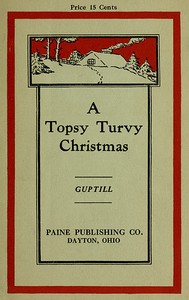
This digital edition of A Topsy-Turvy Christmas — A Reader’s Guide is described by source-level measurements including 12,925 words, 57 min estimated reading time, and 9 detected text sections.
The text analysis averages about 11.9 words per sentence, while the detected sections provide another way to judge how the source is divided.
Project Gutenberg metadata also associates the work with “Christmas plays,” connecting these edition facts with the source record’s subject description.
Explore this collection
These alternatives are selected using recorded categories and estimated reading time.
About 58 minutes
Fantasy Juvenile Worlds
13,322 recorded words. 1 minutes difference from this book's estimate.
View Gutenberg source #18769About 56 minutes
Fantasy Juvenile Worlds
12,688 recorded words. 1 minutes difference from this book's estimate.
View Gutenberg source #27670About 50 minutes
Fantasy Juvenile Worlds
11,400 recorded words. 7 minutes difference from this book's estimate.
View Gutenberg source #68194Search stored excerpts and compare books → Choose by your preferences →
Choices use stored catalog measurements. Estimates vary with reading speed. A shared category is a catalog label, not a claim that two books have the same argument or literary quality.
Search reads excerpt text stored with this catalog and links to its associated Gutenberg record. The connection is stored in the site database; this tool does not recheck that every excerpt is word-for-word identical to that external record. Excerpt search does not cover every chapter and does not verify historical publication dates.
Catalog snapshot checked: 2026-09-26. Coverage: 90 public books, 90 available source excerpts.
Calculated from edition completeness, EPUB availability, text structure and catalogue metadata. Not a user rating.
Total of 100 points, scaled to a 2.5-5.0 range. Editions with an empty description or a missing EPUB file are not scored.
Public-domain source text
The source text is kept in the dedicated reader, separate from this catalogue record and its commentary.
The play opens with Earth children Alice and Frank tumbling into Topsy-Turvy Land, where they encounter characters with reversed names—Gother Moose, Derf, Ecila—and a logic that turns familiar stories inside out. Gother Moose tells a version of “Jack Horner” that dwells on each bite of pie, counting them aloud until the audience protests. The scene establishes a pattern: the script toys with expectation by stretching a simple action into comic repetition, then subverts the expected ending (a plum) with a flat statement that the pie is simply gone. This early moment signals that the play’s humor depends on knowing the original tales and watching them get dismantled.
The most immediate feature of the play is its systematic inversion of names and roles. Mother Goose becomes Gother Moose; the children are named Derf (Fred backward), Ecila (Alice), and Knarf (Frank). This is not merely a gimmick: the reversed names signal that every rule of the familiar world is upended. When Alice asks if Mother Goose is real, Derf replies, “’Course her is!”—a grammatical inversion that matches the topsy-turvy premise. The script extends the wordplay to objects and actions: cats have no tails, and the terrible Wincheopactylus wears its tail over its left shoulder. These details are delivered without explanation, as if the characters themselves find nothing odd about them. The cumulative effect is a linguistic game that rewards attention to how words are twisted.
Gother Moose’s storytelling relies on exaggerated repetition. In the “Hackey Jorner” tale, the narrator lists each bite: “he took another, then he took another, then he took another, then he took another, then he took another, then he took another, then he took another, then he took another, then he took another, then he took another, then he took another, then he took another, then—”. The audience (and the Earth children) grow impatient, but the storyteller insists on counting. This technique turns a simple action into a running gag, testing how long the listener will tolerate the pattern before demanding progress. The same structure appears in “Little Po Beeb,” where the counting of woolly cats (one through twelve) is drawn out. The play uses repetition not as filler but as a deliberate pacing tool that mirrors the topsy-turvy world’s indifference to narrative efficiency.
The script varies its tempo between rapid dialogue and extended set pieces. The Greenies’ entrance, for example, shifts into a rhyming chant: “The Greenies are we. / As sly as can be, / We creep to your window, at night, you see.” The stage direction instructs them to “shout out the fourth line as loudly as possible,” creating a sudden burst of energy. In contrast, Gother Moose’s stories slow the action to a near halt, forcing the audience to sit through the repetition. The Earth children’s interjections—Frank’s “Oh, go on!” and Alice’s attempts to guess the endings—serve as a proxy for the audience’s own reactions. This interplay between performer and listener is built into the script, making the pace feel responsive rather than fixed. The play thus becomes a collaborative game of expectation and surprise.
Readers approaching A Topsy-Turvy Christmas as a performance text will find its humor depends on timing and audience familiarity with the original nursery rhymes. The script rewards those who catch the inversions and tolerate the deliberate drags. It is best read aloud, with attention to the rhythm of the repeated lines and the deadpan delivery of absurd rules. The play does not explain its world; it simply presents it, leaving the reader to piece together the logic of Topsy-Turvy Land from the clues scattered in the dialogue.
I keep thinking about how the chaotic warmth of A Topsy-Turvy Christmas lingers, its playful inversions reminding me of winter evenings spent wrestling with Strindberg’s own strange worlds. There’s a quiet kinship in how both scripts twist expectation into something tender and unsettling. I drifted to Plays by August Strindberg, Second series — Text and Context almost without noticing, like following a familiar trail in fresh snow.
Save your reaction, strongest insight, and memorable passage.